Bitcoin to Monero: The Ultimate Privacy Upgrade
Thinking about swapping Bitcoin to Monero? Here’s when it makes sense, what privacy really means, and how to do a safer BTC→XMR swap in minutes.

| Feature | Bitcoin (BTC) | Monero (XMR) |
|---|---|---|
| On-chain privacy | Low by default | High by default |
| Amount visibility | Public | Hidden |
| Sender/receiver visibility | Often inferable | Obfuscated |
| Typical exchange support | Very broad | More restricted in some regions |
| Best for | Mainstream liquidity, store of value, broad acceptance | Private payments, private savings movement |
Every time you spend it, you’re basically leaving a breadcrumb trail on a public ledger that never forgets.
That’s why “Bitcoin to Monero” has become the classic privacy upgrade. Not because people are doing anything shady—but because normal people don’t want their salary, savings, donations, and purchases to be an open book.
As of 2026-01-28, the market snapshot looks like this: Bitcoin (BTC) $88,884 (+0.95% 24h) and Monero (XMR) $473.42 (+0.10% 24h). Prices change fast, but the privacy logic behind BTC → XMR barely changes at all.
---
TL;DR (Quick Summary)
- BTC is traceable by default. Addresses aren’t “names,” but the flow of funds can often be mapped.
- XMR is private by default. Amounts, sender, and receiver are obscured on-chain.
- People swap BTC to XMR for practical privacy: personal safety, business confidentiality, and financial dignity.
- A “private coin” doesn’t magically make you private—your operational habits still matter.
- If you want a fast, simple path, you can swap using SwapRocket’s non-custodial, no-KYC flow via the BTC to XMR exchange page.
---
The “privacy upgrade” story nobody tells you
Let me paint a painfully common scenario.You receive BTC from a client. Later, you pay rent, buy a laptop, or send funds to a family member. You’re not laundering money—you’re living your life.
But if that BTC came from a KYC exchange withdrawal, or if one wallet address gets linked to you even once, the trail can suddenly connect:
- your income
- your spending patterns
- your savings balance
- who you pay (and when)
That’s when people discover something uncomfortable: Bitcoin can feel like cash, but it behaves more like a public checking account.
Monero is what many privacy advocates reach for next—because it was designed specifically to prevent this kind of financial “x-ray vision.”
Why people swap Bitcoin to Monero (it’s not just ideology)

Privacy conversations online can get weird fast—either overly technical or overly dramatic.
In the real world, BTC → XMR is popular for simple, human reasons.
1) “I don’t want my net worth to be a spectator sport”
If someone can tie one of your BTC addresses to your identity, they may be able to estimate your holdings.Even if they don’t get an exact number, a rough range is sometimes enough to make you a target (doxxing, extortion attempts, social engineering).
2) Freelancers and businesses protecting sensitive cashflow
Businesses don’t publish their bank statements. They shouldn’t have to publish their crypto statements either.- Monero’s default privacy is appealing if you:
- pay contractors
- receive customer payments
- donate to causes
- operate in a competitive niche
3) Donating without broadcasting your life story
Plenty of people want to donate privately—religious giving, mutual aid, political donations, support for friends.With BTC, donors sometimes accidentally reveal far more than they intended. With XMR, the on-chain footprint is designed to be opaque.
4) “I just want financial privacy, the way I have it in everyday life”
Most people don’t share their salary or spending history publicly.Monero supporters argue crypto shouldn’t be different by default.
5) Reducing surveillance risk (especially across multiple transactions)
Bitcoin analytics can get more confident over time.The more you transact, the more patterns emerge. Many users swap a portion of BTC to XMR specifically to avoid creating a long-term, easily clustered history.
BTC vs XMR: what changes when you swap?
Here’s the cleanest way to understand it.Bitcoin is transparent. Monero is private-by-default.
A simple comparison (keep this mental model)
Important nuance: this doesn’t mean “Monero is invisible.” It means the chain itself is designed to avoid leaking the key data that makes analytics easy.
The privacy reality check: swapping to XMR doesn’t fix everything
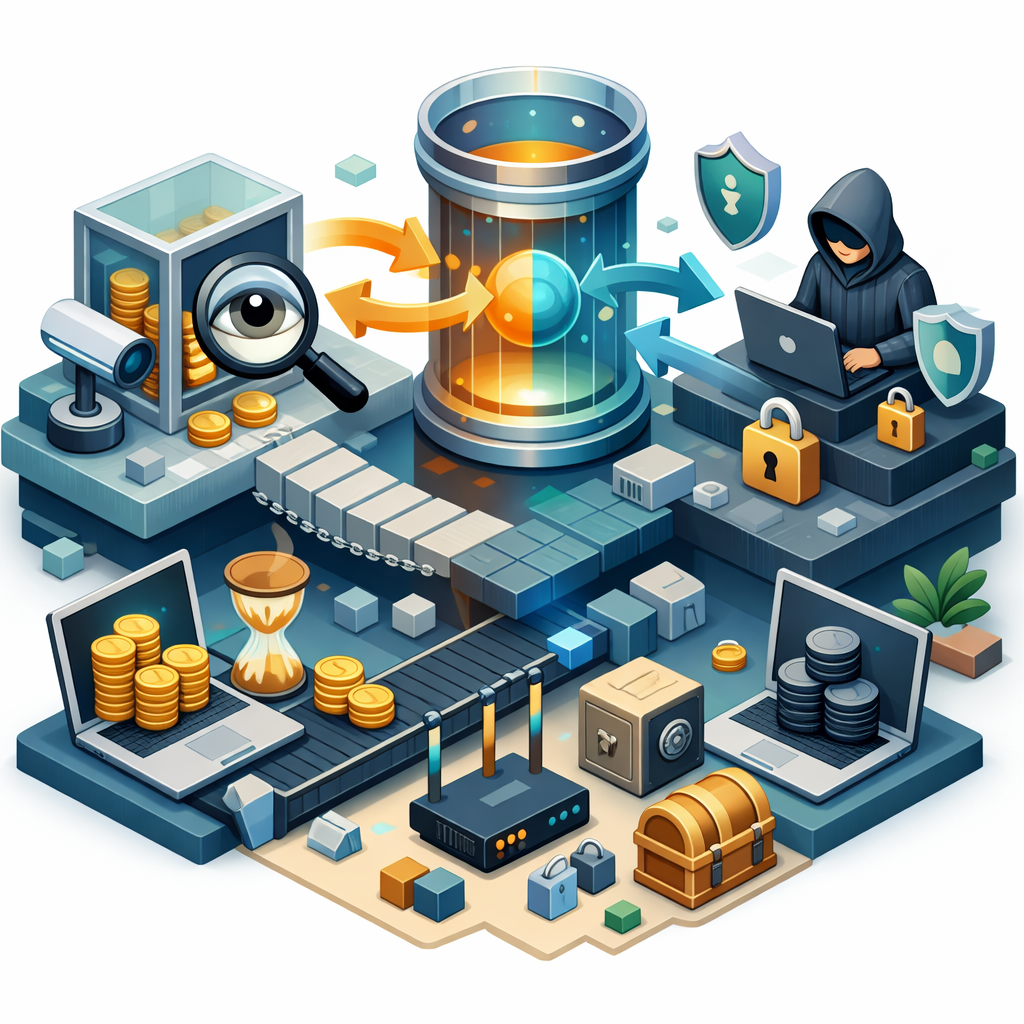
This is where people mess up.
They do one “privacy swap,” then immediately undo it with bad habits.
What Monero helps with
Monero is designed so that: - transaction amounts are not publicly visible - sender/receiver links are obfuscated - address reuse doesn’t create the same public trail as BTCSo yes—it’s a massive privacy upgrade on-chain.
What Monero does not automatically solve
You can still leak privacy through:- Centralized exchange accounts (KYC records): If you buy/sell through KYC rails, the on-chain privacy may not matter as much.
- Careless address sharing: Posting wallet addresses publicly can still create metadata trails.
- Timing and behavior patterns: Repeating the same swap size at the same time each week is a fingerprint.
- Re-depositing to KYC exchanges immediately: If you swap BTC→XMR and then send XMR to a regulated exchange account in your name, you may re-link activity.
Monero is a privacy tool—not a magic cloak.
When does swapping BTC to XMR actually make sense?
Let’s be practical. You don’t need XMR for everything.Here are situations where it often does make sense.
Scenario A: You’re taking profits but don’t want your wallet broadcast
In bull markets, people get emotional.Greed whispers: “Hold forever.” Fear whispers: “Sell everything.” And your brain tries to thread the needle.
- One middle-ground strategy some privacy-minded users take:
- keep long-term BTC holdings intact
- swap a portion into XMR for private storage/movement
This is less about “timing the market” and more about reducing your public financial footprint.
Scenario B: You’re paying someone and privacy matters
Maybe you’re paying: - a consultant - a developer - a friendIf that person can see your BTC transaction history (or derive it), it can get awkward fast.
XMR avoids that “here’s my whole wallet history” problem.
Scenario C: You live in a place where privacy equals safety
Your analytics show meaningful traffic from countries with different risk profiles.In some regions, being visibly “crypto-rich” can increase personal security risk. Even in the US or UK, it’s not unheard of for people to be targeted after being publicly linked to crypto.
Privacy isn’t paranoia—it’s risk management.
Scenario D: You’re separating identities (clean bookkeeping)
Many users keep separate “buckets” of funds: - public-facing BTC wallet (for receiving) - private savings/movement (XMR)Not because they’re hiding wrongdoing, but because they want boundaries.
Common mistakes people make (and how to avoid them)
If you remember nothing else, remember this section.Mistake #1: Swapping your entire stack “because privacy”
That’s usually emotion, not strategy.- A more rational approach is to decide:
- what portion you want private
- what portion you want highly liquid and widely accepted
Even 5%–20% allocation for privacy use-cases can be meaningful, depending on your needs. (Not financial advice—just a reality check.)
Mistake #2: Ignoring network fees and sending too little
BTC fees fluctuate. XMR fees are usually modest.If you’re swapping small amounts, the BTC network fee can eat a noticeable percentage of your total. For a $50 swap, a $5 fee is brutal (10%).
- Before you swap, sanity-check:
- BTC miner fee at the time
- the platform’s quoted rate and any included spread
If you want to estimate values before committing, use the SwapRocket converter to get a quick feel.
Mistake #3: Reusing addresses and creating patterns
Even though XMR is privacy-first, your behavior still matters.- Better habits:
- don’t publish your addresses
- avoid repeating identical swap sizes on a fixed schedule
- split large swaps into a couple of chunks if you’re concerned about patterning
Mistake #4: Treating “no-KYC” as “no rules”
No-KYC platforms are about privacy and accessibility.But your local tax and reporting obligations may still apply. In many jurisdictions, swapping BTC to XMR is a taxable event.
If you’re unsure, talk to a tax professional. (I’m not one.)
A quick note on alternatives (and why people still choose XMR)
Sometimes people ask: “Why not just use a stablecoin?”Stablecoins solve a different problem: volatility.
- They do not reliably solve privacy:
- most stablecoins are issued/controlled by centralized entities
- they can be monitored and, in some cases, frozen at the issuer level
If your goal is “I want my balances and counterparties to be private,” stablecoins usually aren’t the right tool.
If your goal is “I want to park value in dollars during chaos,” stablecoins can make sense.
(If you’re exploring that angle too, SwapRocket has dedicated routes like ETH to USDT and quick converters like BTC to USDT converter—just remember: stability ≠ privacy.)
Choosing a swap method: what to look for (without the marketing fluff)
There are three big buckets:1) Centralized exchanges (CEXs)
Pros: - deep liquidity - familiar UI- Cons:
- often KYC required
- account risk (freezes, withdrawals delayed)
- you don’t control keys while funds are on-platform
2) Peer-to-peer (P2P)
Pros: - can be private depending on method- Cons:
- more time and coordination
- scams and chargebacks (depending on payment rails)
3) Instant swap platforms (non-custodial flow)
Pros: - typically no accounts - fast execution - you keep control of receiving wallet- Cons:
- rates vary by provider
- requires careful address handling
This is the lane where SwapRocket is built to be useful: non-custodial, no-KYC, and typically minutes from start to finish, with competitive rates via liquidity aggregation across a large set of assets (200+).
If you want to explore what’s available beyond BTC and XMR, the full list is here: Supported cryptocurrencies.
How to swap BTC to XMR on SwapRocket (focused step-by-step)
This is the only “how-to” section you need. Keep it simple, and don’t rush.Step 1: Open the BTC → XMR pair
Go straight to the dedicated page: BTC to XMR exchange.You can also start from the main Exchange page and select BTC and XMR.
Step 2: Enter the amount and check the quote
Type how much BTC you want to swap.- Before you click through, pause for 10 seconds and confirm:
- you’re comfortable with the rate shown
- you understand BTC network fees may apply
- you’re sending enough that fees don’t wreck the swap
If you like sanity-checking first, open the converter in another tab.
Step 3: Paste your XMR receiving address (carefully)
This is the most important moment.Monero addresses are long. Don’t “eyeball it.”
- Do:
- copy/paste from your Monero wallet
- double-check the first and last 4–6 characters
- consider using a fresh receiving address/subaddress if your wallet supports it
Step 4: Send BTC to the deposit address shown
SwapRocket will show where to send your BTC.- Send the exact amount requested, and don’t forget:
- BTC confirmations can take time depending on mempool conditions
- fees you choose in your wallet can speed up or slow down confirmation
Step 5: Wait for the swap to complete (typically minutes)
Once BTC is confirmed and processed, XMR is sent to your address.If anything looks off, your first stop is the FAQ for common questions.
If you need a human, reach out via Contact.
That’s it. No accounts. No custody handover. No identity upload.
Privacy checklist: do this before and after your swap
If you want the “privacy upgrade” to actually stick, adopt a few habits.Before the swap
- Use your own wallet for receiving XMR (don’t swap into an exchange deposit address). - Avoid swapping right after a doxxing event (like tweeting a wallet address). Time separation helps. - Don’t overshare: screenshots of swaps, transaction IDs, amounts, timestamps—these are breadcrumbs.After the swap
- Let the funds breathe: avoid immediately bouncing XMR into a KYC exchange tied to your name. - Keep your notes private: if you track taxes, store records securely (local encrypted notes or a dedicated tool). - Practice “need-to-know” payments: if a counterparty doesn’t need to know your holdings, don’t give them a trail.Mini case studies (realistic, not fairy tales)
Here are three “normal person” reasons BTC → XMR keeps showing up.Case study 1: The freelancer who didn’t want clients tracking income
Jade is paid in BTC.One client asked for a refund and casually mentioned they could “see” Jade’s wallet received payments from other clients too. Not malicious—just nosy.
Jade started swapping a portion of incoming BTC to XMR monthly.
Result: clients can still pay in BTC, but Jade’s long-term savings movements aren’t a public dashboard.
Case study 2: The donor who wanted boundaries
Sam donates to a cause.With BTC, Sam worried that the receiving organization (or anyone watching) could infer Sam’s overall holdings. So Sam swapped BTC → XMR and donated in XMR.
Result: donation happened, but Sam didn’t broadcast their financial life.
Case study 3: The “I’m not hiding, I’m minimizing risk” saver
Alex lives in a place where getting targeted for crypto holdings is a real thing.Alex keeps most savings in BTC, but swaps a smaller portion into XMR for private contingency funds.
Result: not a political statement—just safety planning.
“Is Monero risky?” The honest trade-offs
If you’re considering XMR, you deserve the full picture.The upsides
- strong on-chain privacy by design - widely used in privacy communities - useful for private payments and private movement of valueThe trade-offs
- exchange support varies: some regulated venues restrict XMR - perception risk: privacy tech is sometimes misunderstood - self-custody responsibility: if you lose your wallet access, nobody can “reset your password”Most people handle this by using XMR for what it’s great at (privacy) while keeping some BTC/ETH exposure for liquidity and ecosystem access.
If you’re new: the simplest way to get started safely
If you’re just stepping into privacy-focused swaps, keep it boring.- A sensible first run looks like:
- do a small test swap first (even 1–5% of what you plan)
- confirm XMR arrives in your wallet
- only then do the larger swap
That one habit alone prevents most “I pasted the wrong address” disasters.
If you’re still learning the basics of Monero privacy, this deeper guide is worth your time: Monero (XMR) Privacy Guide: Everything You Need to Know.
And if you want a dedicated walkthrough focused on the no-KYC angle, read: How to Swap BTC to XMR Without KYC: Complete 2025 Guide.
Related Reading
- Monero (XMR) Privacy Guide: Everything You Need to Know About Private Crypto - How to Swap BTC to XMR Without KYC: Complete 2025 Guide - Exchange BTC to XMR No KYC: Private, Fast and SecureReady to do the privacy upgrade?
If you’ve read this far, you already know the real point: BTC is powerful money, but it isn’t private money.When you want privacy that’s built in—not bolted on—swapping a portion of BTC to XMR can be a smart, grounded move.
Use SwapRocket if you want a straightforward path: non-custodial swaps, no KYC, typically completed in minutes, with competitive rates across 200+ supported assets.
Start here: Swap BTC to XMR on SwapRocket. If you have questions before you swap, the FAQ is a good first stop.