On-Chain Privacy: What Your Crypto Reveals
Your wallet isn’t “anonymous.” Learn what on-chain data reveals, how analysts connect addresses, and practical steps to protect your privacy.

| Approach | Privacy Strength | What it protects you from | Biggest tradeoff |
|---|---|---|---|
| Basic hygiene (new addresses, wallet separation) | Medium | Casual snooping, easy clustering mistakes | Requires discipline and planning |
| No-KYC, non-custodial swapping | Medium–High | Identity collection, account-based tracking | Still on-chain; timing/amounts can link |
| Privacy wallets/coin control (UTXO management) | Medium–High | UTXO clustering, address reuse | More manual; can be confusing at first |
| Privacy coins (e.g., Monero) | High | On-chain tracing and graph analysis | Fewer integrations; extra steps to move in/out |
On-chain, it can be even simpler: one wallet deposit to a KYC exchange, one NFT mint, one “oops I reused the same address,” and suddenly your crypto life starts looking like a public scrapbook.
And here’s the weird part: most people who get doxxed by blockchain analytics aren’t doing anything shady. They’re just… normal. Paying for stuff, moving funds between wallets, swapping tokens, cashing out once in a while.
TL;DR (save this for later)
If you only remember a few things, make it these:
- Blockchains like Bitcoin and Ethereum are public ledgers. Your transactions are visible forever.
- “Address ≠ identity”… until it is. A single connection (exchange deposit, posted ENS, social post, NFT activity) can tie you to an address cluster.
- Clustering is real. Analysts can often infer which addresses belong to the same person using patterns like change outputs (BTC) or repeated funding sources (EVM chains).
- Stablecoins can be privacy-hostile. USDT/USDC transfers are easy to follow and often tied to centralized rails.
- Better privacy is mostly about habits. New addresses, wallet separation, avoiding “one big hub wallet,” and using privacy-preserving assets/tools where appropriate.
- No-KYC + non-custodial swaps help reduce exposure. Platforms like SwapRocket let you swap without handing over your identity or giving up your keys.
(Market snapshot: This guide reflects typical on-chain conditions and analytics techniques as of Jan 2026—no live pricing or mempool data used.)
---
The myth of “anonymous” wallets (and why it persists)
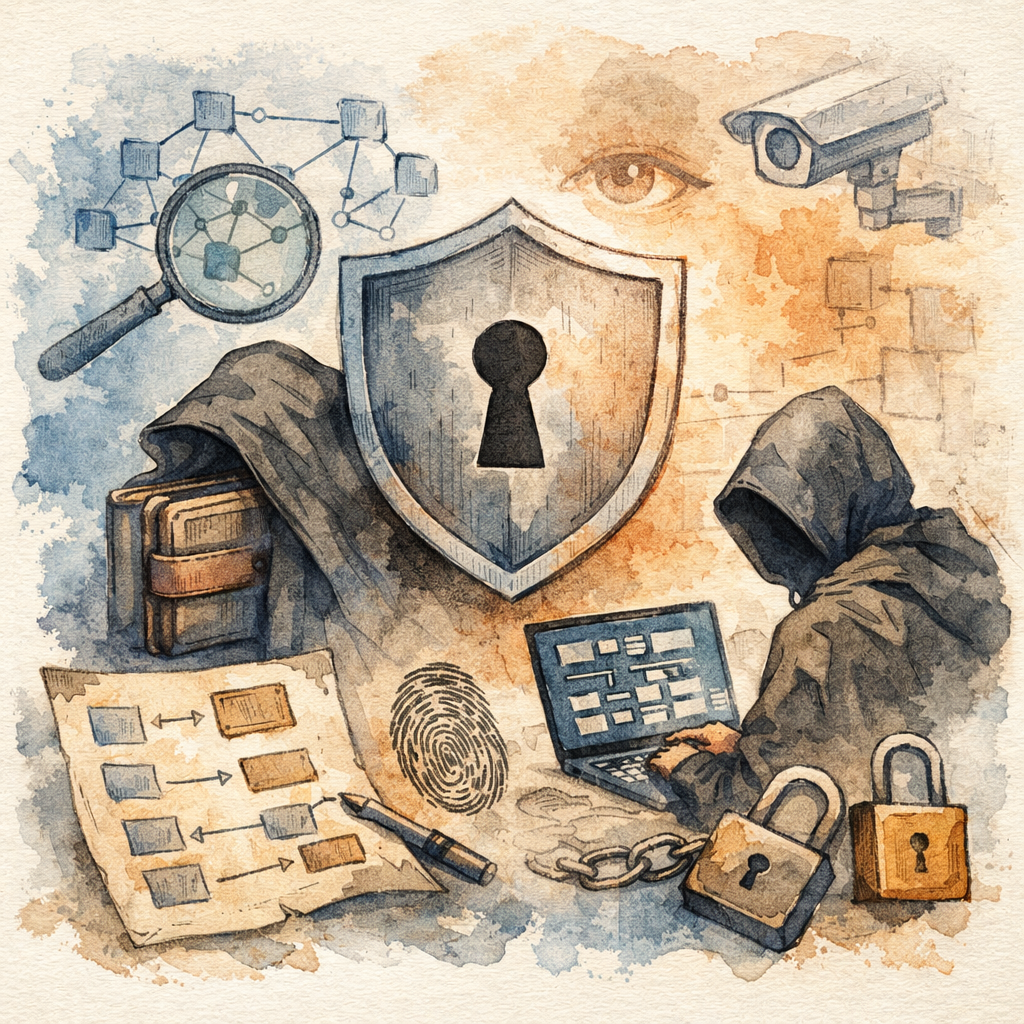
If you’re new to crypto, it’s natural to assume wallets are anonymous.
After all, your address looks like random characters. No profile photo, no phone number, no home address.
But a better mental model is this: most blockchains are like a glass bank account. People might not know it’s yours at first, but once they do, they can scroll through years of history—deposits, withdrawals, counterparties, amounts, and timing.
A quick story: the “one-time” exchange deposit that wasn’t
Say you buy $500 of ETH on a centralized exchange.
You withdraw it to your MetaMask. Later you swap into USDT for a while. Then you send that USDT to a friend. Then you bridge some funds to another chain. Then you buy an NFT.
If that exchange withdrawal is tied to your identity (KYC), an analyst can often trace:
- the withdrawal address
- the addresses it interacts with
- the assets you hold
- your typical transaction sizes and patterns
It’s not magic. It’s just… data.
And on public chains, data tends to compound.
---
What your transactions reveal (even if you never share your name)
Think of your on-chain footprint like “behavioral metadata.” Even without your name, it can paint a surprisingly clear picture.
Here are the big buckets analysts look at.
1) Your balances (present and past)
On many chains, anyone can see:
- what tokens you hold
- how much you hold
- when you acquired them
- when you sold
If you ever held 10 ETH at once, that historical snapshot can be visible even if your current balance is 0.
2) Your counterparties
When you send funds, you create a link.
If one side of that link is known (an exchange hot wallet, a merchant processor, a public donation address), it becomes a “tag” in the graph.
3) Your habits (timing + amounts)
Humans are patterned.
Analysts love patterns like:
- recurring transfers (salary-like payments)
- “round numbers” ($500, $1,000) vs. organic amounts ($487.23)
- specific time-of-day activity (e.g., weekends, lunch hours)
- “peel chains” (repeatedly sending small portions out of a larger pot)
Even if no single pattern identifies you, multiple patterns together can.
4) Your network and device fingerprints (indirectly)
This isn’t strictly on-chain, but it matters.
If you use wallets, dApps, RPC providers, or explorers that log IP addresses or analytics, your privacy can be weakened—especially if those services are tied to accounts, cookies, or browser identity.
---
How blockchain analysis actually works (in plain English)

When people hear “blockchain analysis,” they imagine hackers.
In reality, it’s closer to what advertisers do: build a graph, label known points, and infer the rest.
The core idea: transaction graphs
Every transfer creates a relationship.
Over time, those relationships form a graph of:
- addresses
- transactions
- assets
- timestamps
- smart contracts
If analysts can label even a few nodes (like “Coinbase deposit wallet” or “Binance hot wallet”), they can often map activity around them.
Address tagging: the easy wins
A lot of “identity leaks” come from simple tagging:
- You deposit to a KYC exchange (your account ties to that deposit address).
- You publish a wallet for donations on social media.
- You use an ENS name that links to your profile.
- You sign a message publicly to prove ownership.
Once a tag exists, it’s durable.
Address clustering: the part that surprises people
Clustering is when analytics tools infer that multiple addresses are controlled by the same entity.
The heuristics differ by chain.
#### Bitcoin-style UTXO chains: “inputs belong together” + change
Bitcoin doesn’t have “accounts” like Ethereum. It has UTXOs (unspent outputs), like bills in your wallet.
When you spend BTC, you often combine multiple “bills” (inputs). A common heuristic is:
- If multiple inputs are used in one transaction, one entity likely controlled them (because you needed the private keys to spend them).
Then there’s change.
If you spend 0.3 BTC but your UTXO is 1 BTC, you typically send:
- 0.3 BTC to the recipient
- ~0.7 BTC back to a “change address” you control
Analysts try to guess which output is change based on patterns (address type, amount, reuse, script format).
This is why a “simple BTC payment” can quietly link addresses together.
#### Ethereum/EVM chains: funding sources + behavior
Ethereum is account-based, so clustering looks different.
Analysts often use:
- common funding source (multiple wallets funded from the same exchange withdrawal)
- gas funding patterns (a main wallet sends small ETH for gas to multiple sub-wallets)
- same dApp sequences (wallet A and B doing the same actions in the same order)
- timing correlations (wallets moving in tandem)
None of these are perfect alone. Together, they’re powerful.
Smart contracts make it worse (or better)
Smart contracts create extremely legible footprints:
- token approvals
- swaps
- bridges
- NFT mints
- lending/borrowing positions
One DeFi session can expose more about you than ten simple transfers.
The flip side is that privacy-focused protocols (and privacy coins) exist for a reason.
---
The “privacy leak” hall of fame (things people do every day)
You don’t need an exotic mistake to lose privacy. Here are common ones.
Reusing the same address like it’s an email
On some chains, address reuse is normal. But privacy-wise, it’s brutal.
If you receive payments to one address repeatedly, you’re basically running a public “income page.”
Using one wallet for everything
One wallet for:
- salary
- savings
- DeFi
- NFT mints
- gambling tokens
- donations
…means one leak connects the entire story.
Bridging and swapping without thinking about traceability
Bridges and swaps are where people assume they “reset” history.
Sometimes you do reduce linkability. Often you don’t—especially if:
- you bridge the exact same amount within minutes
- you swap large amounts with distinctive sizes
- you use the same destination wallet every time
Stablecoins: great for price stability, not great for privacy
Stablecoins like USDT are fantastic for “parking value.”
But from a privacy angle:
- they move on transparent ledgers
- they often touch centralized rails (exchanges, payment services)
- they can be monitored at scale due to standardized token contracts
If you frequently swap into stablecoins, consider doing it in a way that minimizes identity exposure.
If you’re actively converting, tools like an ETH to USDT swap or a SOL to USDT converter are convenient—but the privacy outcome depends on how you structure the flow (wallet separation, timing, amounts).
---
A simple comparison: privacy options and tradeoffs
No single tool fixes everything. Here’s a practical comparison to help you choose the right approach for your situation.
If you want the “most privacy for the least complexity,” start with hygiene + no-KYC swaps, then level up from there.
---
Practical privacy moves (without going full paranoid)
Privacy isn’t a binary. It’s a slider.
Here are the habits that deliver outsized results for most people.
1) Separate wallets by purpose (your new secret weapon)
This is the one change that instantly reduces the blast radius of mistakes.
Try a simple setup:
- Vault wallet: long-term holding (rarely interacts)
- Spending wallet: daily activity, smaller balances
- DeFi/NFT wallet: higher risk, more public activity
If your DeFi wallet gets linked to your identity, your vault wallet stays quieter.
2) Stop thinking in “one big balance”
People love having one wallet with everything.
Analysts love it even more.
Instead:
- move only what you need for a specific task
- keep “clean” funds separate from “highly public” funds
3) Avoid clean 1:1 timing and amount links
If you move exactly 2,000 USDT from A → swap → B within 3 minutes, you’re leaving a breadcrumb trail.
To reduce obvious linkage:
- consider varying timing (not always immediate)
- avoid distinctive amounts when possible
- don’t funnel everything to one “main” address
You’re not trying to be invisible. You’re trying to be harder to confidently match.
4) Use no-KYC swaps to reduce identity collection
A lot of privacy loss doesn’t come from the blockchain itself.
It comes from the moment you hand over:
- passport/selfie
- address
- transaction history
- device data
- account logins
With a non-custodial, no-KYC swap flow, you reduce the “identity anchors” that make graph analysis trivial.
On SwapRocket’s exchange, you can typically swap in minutes while:
- staying non-custodial (you control your funds)
- avoiding KYC in the flow
- accessing competitive rates via liquidity aggregation
- choosing from 200+ supported cryptocurrencies (see supported currencies)
If you’re the type who wants to check numbers before moving, the converter is a simple way to estimate outputs without overthinking it.
5) Consider privacy-preserving assets for high-sensitivity moves
If you’re doing something where privacy really matters—journalism, activism, sensitive salary payments, or simply not wanting your net worth public—privacy coins exist for a reason.
Monero (XMR) is the classic example because its design aims to hide:
- sender
- receiver
- amount
If you want the deeper “why,” read this: Monero (XMR) Privacy Guide: Everything You Need to Know About Private Crypto.
And if you want a practical route people commonly use, swapping into XMR can be a useful privacy step. (Here’s a relevant path on SwapRocket: BTC to XMR.)
6) Learn the difference between “privacy” and “security”
They overlap, but they’re not the same.
- Security: stopping theft (hardware wallets, avoiding scams)
- Privacy: controlling who can see your activity (on-chain footprint, identity links)
You can be secure and still completely exposed.
And you can be private but insecure (for example, storing seed phrases badly).
Aim for both.
---
Real-world examples: what analysts can infer from normal activity
Let’s make this concrete.
Example A: The stablecoin salary trail
You get paid in USDT on a public chain.
Even if your employer never shares your name, an observer might infer:
- your pay schedule (biweekly/monthly)
- your approximate income
- your spending habits (rent payment size, transfers to exchanges)
If you then move that USDT to an exchange account tied to your identity, the loop closes.
Example B: The “one-time” SOL to ETH conversion
You bridge/swap SOL to ETH when markets get volatile.
If you use a consistent pattern—same time window, same amounts, same destination wallet—someone watching your SOL address can often follow the story across chains.
If you’re doing conversions, it’s fine to use tools like SOL to ETH or a calculator-style converter. Just remember: the swap is the easy part; the privacy is the planning.
Example C: The public NFT wallet that reveals your net worth
NFT wallets are often extremely linkable because people share them publicly.
If that wallet also touches your “serious money” wallet even once, you’ve created a bridge between your public persona and your private holdings.
---
“But I’m not doing anything wrong”—why privacy still matters
Privacy isn’t about hiding crimes.
It’s about avoiding unnecessary exposure in a world where data is permanent.
A few healthy reasons to care:
- Personal safety: public wealth can attract the wrong kind of attention
- Business confidentiality: vendors, payroll, and treasury flows are valuable intelligence
- Negotiation power: if someone knows your exact holdings, you negotiate from weakness
- Future-proofing: what feels harmless today can look different under new rules or new social norms
The goal isn’t secrecy at all costs. It’s choice.
---
A quick “privacy checklist” you can actually follow
If you want a simple starting point, do these 8 things:
- Use separate wallets for savings vs. activity.
- Don’t reuse addresses when you can avoid it.
- Avoid routing everything through one “hub” wallet.
- Be mindful of timing + exact amounts when moving between chains.
- Treat stablecoin movements like public receipts.
- Prefer no-KYC paths when swapping.
- Keep your long-term wallet’s activity boring and minimal.
- When you have questions, check the FAQ before guessing.
If you want a more complete walkthrough of privacy-minded movement, this is worth your time: Privacy-First Crypto Playbook: Move Funds Anonymously.
---
Where SwapRocket fits in a privacy-first strategy
Let’s be honest: most people don’t want a 17-step operational security routine.
They want something simple that doesn’t force them to hand over their identity, and doesn’t require trusting a random custodian with their coins.
That’s exactly where SwapRocket tends to fit best:
- Non-custodial: you’re not depositing into an account and hoping for the best.
- No KYC: you can swap without uploading documents.
- Fast: swaps typically complete in minutes (network conditions matter).
- Competitive rates: liquidity aggregation helps avoid “tourist pricing.”
- Breadth: 200+ assets supported, so you’re not stuck forcing weird routes.
If you’re starting from fiat, you can use Buy Crypto. If you’re cashing out, Sell Crypto is there too—just remember that off-ramps often involve more identity exposure, so plan accordingly.
If you ever want to sanity-check a conversion before swapping, the converter is the quickest place to start.
---
Common questions I hear (and straight answers)
“Can people see my name on the blockchain?”
Not directly on most chains. What they can see is your address activity.
Your name appears when your address gets linked to identity through exchanges, public posts, ENS, merchant tools, or other data sources.
“If I use a new address, am I safe?”
You’re safer, but not invincible.
New addresses help, but clustering and behavioral linking can still connect them—especially if they’re funded from the same sources in obvious ways.
“Do swaps automatically make my funds private?”
Swaps can reduce linkability, but they don’t magically erase history.
If your swap is easy to correlate (same amounts, same timing, same wallets), analysts may still connect the dots.
“What’s the most private way to transact?”
On-chain, privacy-focused designs (like Monero) are generally stronger than transparent ledgers.
In practice, your best approach depends on your needs, risk tolerance, and how much complexity you can handle.
If you’re exploring no-KYC swap workflows, this guide pairs nicely with today’s article: Privacy-First Crypto Swaps: Complete Guide to No-KYC & Anonymous Exchanges (2025).
---
Related reading (go deeper)
- Privacy-First Crypto Playbook: Move Funds Anonymously
- Privacy-First Crypto Swaps: Complete Guide to No-KYC & Anonymous Exchanges (2025)
- Monero (XMR) Privacy Guide: Everything You Need to Know About Private Crypto
---
Ready to swap without giving up your identity?
If you’ve made it this far, you already get the big idea: your on-chain footprint is a data trail.
The good news is you don’t need perfection to get meaningfully better privacy. You just need better defaults—like avoiding KYC collection when you’re simply trying to convert one crypto to another.
When you’re ready, head to SwapRocket Exchange and make your next swap non-custodial, no-KYC, and typically done in minutes. If you want to preview rates first, start with the converter, and if anything’s unclear, the FAQ answers the common “wait, what happens if…?” questions.