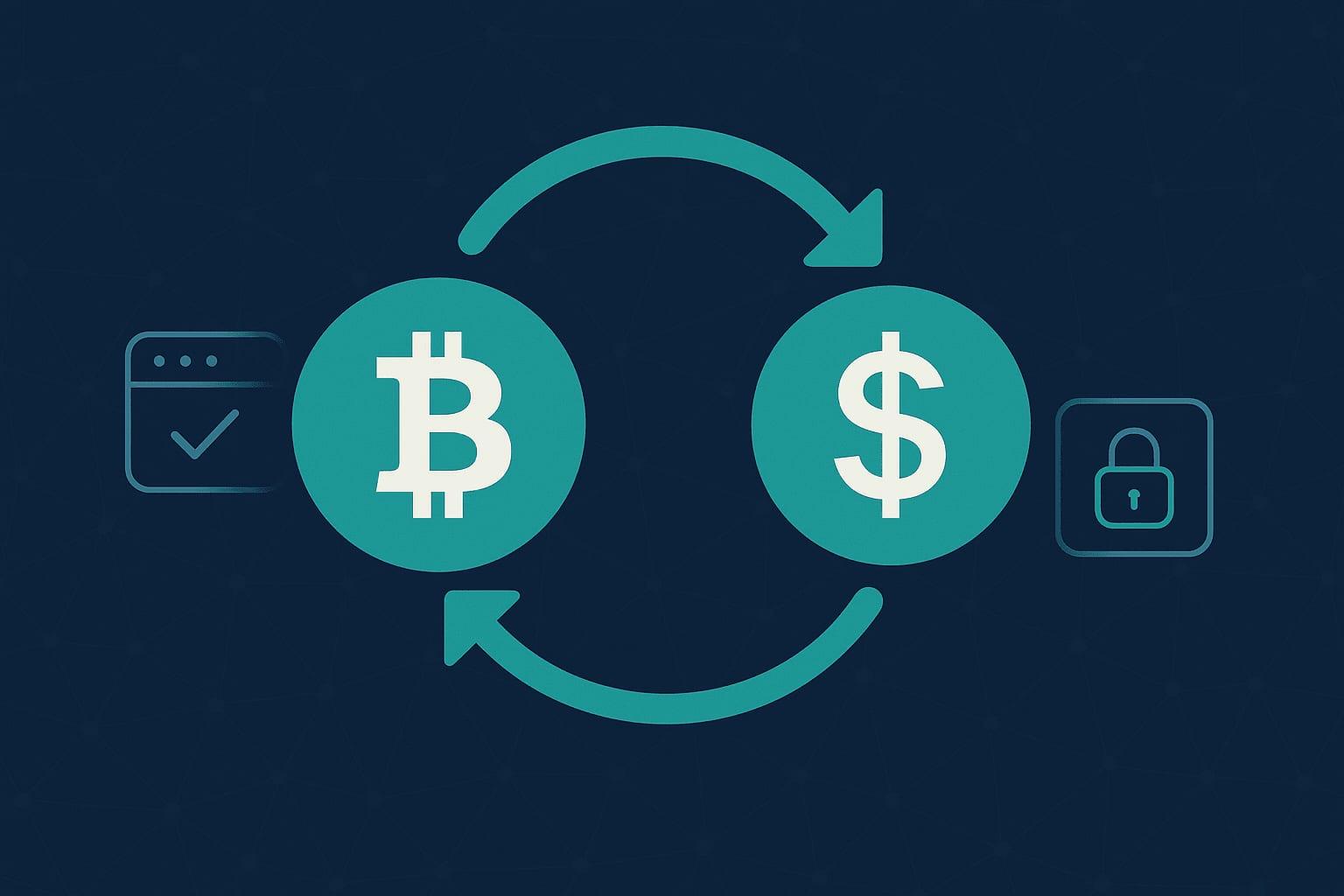
To swap BTC to USDT without KYC, open the BTC to USDT exchange, choose the network you want USDT on, paste a USDT address for that network and send Bitcoin from your own wallet. There is no account, and the USDT typically arrives in 5 to 30 minutes, depending mostly on how fast your Bitcoin deposit confirms.
This guide covers each step, the network choice that trips people up, and what the estimate you see does and does not include. Each coin also has its own page: the Bitcoin (BTC) exchange page and the Tether (USDT) exchange page.
- Pick the USDT network (Tron, Ethereum, BNB Smart Chain and others) that your wallet and your next step support.
- The receiving address must be on that network.
- The rate is floating; the estimate already includes the fee and the USDT payout network fee.
- No account and no KYC for standard swaps. The liquidity provider screens transactions and can, rarely, hold a flagged one for verification.
- SwapRocket pays out crypto only. Turning USDT into money in a bank is a separate step with another kind of service.
Why People Swap BTC to USDT
USDT is a stablecoin designed to track the US dollar. Exchanging Bitcoin for it takes you out of Bitcoin's price swings without leaving crypto.
- Holding a gain. After a rise, swapping part of a position into USDT fixes its dollar value. If Bitcoin then falls, that part does not fall with it. If Bitcoin keeps rising, that part does not rise either, which is the price of the protection.
- Lowering volatility. Holding some of a portfolio in stablecoins reduces how much it swings and leaves funds ready to exchange back later.
- Having the asset others expect. A lot of trading, lending and payments in crypto is denominated in USDT, and it is cheap to move on fast networks.
A stablecoin is not risk-free: you take on the issuer and the network it runs on. And in many countries swapping BTC for USDT is a taxable disposal of the Bitcoin. See when swapping to stablecoins is smart and when it is risky.
Which USDT Network to Receive On
"BTC to USDT" means Bitcoin in, Tether out. The detail that matters is which blockchain the USDT arrives on, because the same token exists on several and they are not interchangeable.
| Network | Address looks like | Typical use | Cost to move later |
|---|---|---|---|
| Tron (TRC-20) | Starts with T | Transfers, many exchange deposits | Low |
| BNB Smart Chain (BEP-20) | Starts with 0x | BNB ecosystem apps | Low |
| Ethereum (ERC-20) | Starts with 0x | Ethereum DeFi, widest support | Higher, varies with gas |
Choose by where the USDT is going next. If you will deposit it somewhere, check which network that destination accepts. If it stays in your wallet, pick a network your wallet supports and remember you will need a little of that chain's native coin (TRX, BNB or ETH) to move it later. The USDT networks guide goes deeper.
Three Ways to Swap BTC to USDT
| Method | Identity check | Who holds the coins | Suits |
|---|---|---|---|
| Centralized exchange | Required | The exchange, until you withdraw | Frequent trading, limit orders, cashing out to a bank |
| Peer-to-peer market | Depends on the platform | Escrow, then the counterparty | Trades that involve cash or bank transfers |
| Non-custodial swap service (SwapRocket) | None for standard swaps | You send from your wallet and receive to your wallet | A direct BTC to USDT swap without an account |
Bitcoin is not on the chains where USDT lives, so a DEX cannot swap native BTC for USDT directly; you would have to wrap or bridge it first. A swap service takes native BTC and pays out native USDT on the network you pick. How no-KYC exchanges work explains the model.
Step-by-Step: Swap BTC to USDT on SwapRocket
You need Bitcoin in a wallet you control and a USDT address on the network you chose.
Step 1: Open the pair
Go to the BTC to USDT exchange. BTC is the coin you send; select USDT on your network as the coin you receive.
Step 2: Enter the amount
Type how much BTC you want to swap. You will see the estimated USDT you will receive and the minimum for the pair. The estimate already includes the service fee and the payout network fee, and nothing is added afterwards. Because the rate is floating, the final amount follows the market until your deposit is processed.
Step 3: Paste your USDT address
Paste the address and compare the first and last characters with your wallet. The form checks the address against the selected network, but only you can check that it is yours. Add a refund address (a Bitcoin address you control) in case the swap cannot be completed.
Step 4: Send the Bitcoin
After you confirm, you get a one-time Bitcoin deposit address. Send the BTC from your wallet with a normal or higher network fee. A deposit that sits unconfirmed is the usual cause of a slow swap. Save the swap ID.
Step 5: Receive the USDT
When the deposit has confirmed, the licensed liquidity provider executes the swap and sends USDT to your address. A typical swap takes 5 to 30 minutes; a congested Bitcoin network makes it longer. For more on timing, see how long crypto swaps take.
What You Pay
Three costs are involved:
- The Bitcoin network fee for your deposit, paid from your wallet to miners.
- The service fee, included in the rate.
- The USDT payout network fee, also included in the estimate.
Because the second and third are already inside the number you see, the simplest way to judge the swap is the USDT amount itself. If you want a reference, compare it with the BTC price on a market index. Crypto swap fees: the hidden costs breaks each part down.
Ways to keep more of the result:
- Go direct. BTC to another coin to USDT means paying twice.
- Receive on the network you actually need, so you do not pay to move it again.
- Avoid sending when Bitcoin fees are spiking, if you can wait.
- Send soon after checking the estimate, since the rate floats.
Safety Checklist
- Check the URL. Make sure you are on swaprocket.io, from a bookmark rather than an ad or a message.
- Match the network. USDT on Tron needs a Tron address; USDT on Ethereum needs an Ethereum address.
- Verify the address after pasting. Clipboard malware swaps addresses.
- Test first with a small amount when moving a large sum.
- Keep the swap ID. If something looks wrong, email support@swaprocket.io with it.
- Know the limits. SwapRocket is not offered to residents of the United States or the United Kingdom.
Other Swaps From Here
- USDT to BTC exchange for the way back
- BTC to ETH exchange, with a BTC to ETH guide
- BTC to XMR exchange, with a BTC to XMR guide
- USDT to ETH exchange
- BTC to USDT converter if you only want to check the numbers
Related Reading
- How to Swap USDT to BTC Without KYC
- How Crypto Traders Use Stablecoins
- Mempool 101: Why Your Transaction Is Stuck
- SwapRocket FAQ
Frequently Asked Questions
How long does a BTC to USDT swap take?
Typically 5 to 30 minutes. Most of that is waiting for the Bitcoin deposit to confirm, so a busy network or a low fee on your transaction makes it longer.
Do I need KYC to swap BTC to USDT?
Not for a standard swap on SwapRocket: there is no account, no email and no document upload. The licensed liquidity provider that executes the swap screens transactions and can, rarely, hold a flagged one and ask for verification.
Which USDT network should I choose?
The one your wallet and your next destination support. TRC-20 and BEP-20 are cheap to move afterwards, while ERC-20 has the widest support and higher gas costs.
Is the BTC to USDT rate fixed?
No. SwapRocket uses a floating rate, so the final amount follows the market until your deposit is processed. The estimate shown before you send includes the fee and the payout network fee.
Can I swap BTC to USDT and withdraw to my bank?
Not on SwapRocket. It exchanges crypto for crypto and pays USDT to your wallet address. Converting USDT to money in a bank account needs a separate service that handles fiat, which will normally verify your identity.