An "anonymous crypto exchange" is a service that swaps one cryptocurrency for another without an account, an email address or identity documents. That makes it private rather than truly anonymous: the swap still settles on public blockchains, and the licensed provider that executes it screens transactions. This guide covers what such an exchange keeps private, what it cannot hide, and how to use one safely.
SwapRocket works this way. On the no-KYC crypto exchange page you pick two coins, paste the address that should receive the new coin, and send from your own wallet. If you only want the mechanics, read how no-KYC crypto exchanges work.
- An anonymous crypto exchange swaps crypto for crypto with no account and no identity check for a standard swap.
- It does not make you invisible. Deposits and payouts are public on-chain, and a flagged transaction can be held for verification.
- SwapRocket is a non-custodial, no-KYC exchange for 700+ assets. One licensed liquidity provider executes each swap.
- A typical swap takes 5 to 30 minutes, set mostly by how fast the coin you send confirms.
- Tax rules apply to a swap whether or not the service asked for your ID.
What Is an Anonymous Crypto Exchange?
It is a crypto-to-crypto exchange that does not ask who you are for a standard swap. No registration, no passport upload, no selfie, no bank account. You give it one piece of information: the wallet address where the new coins should go.
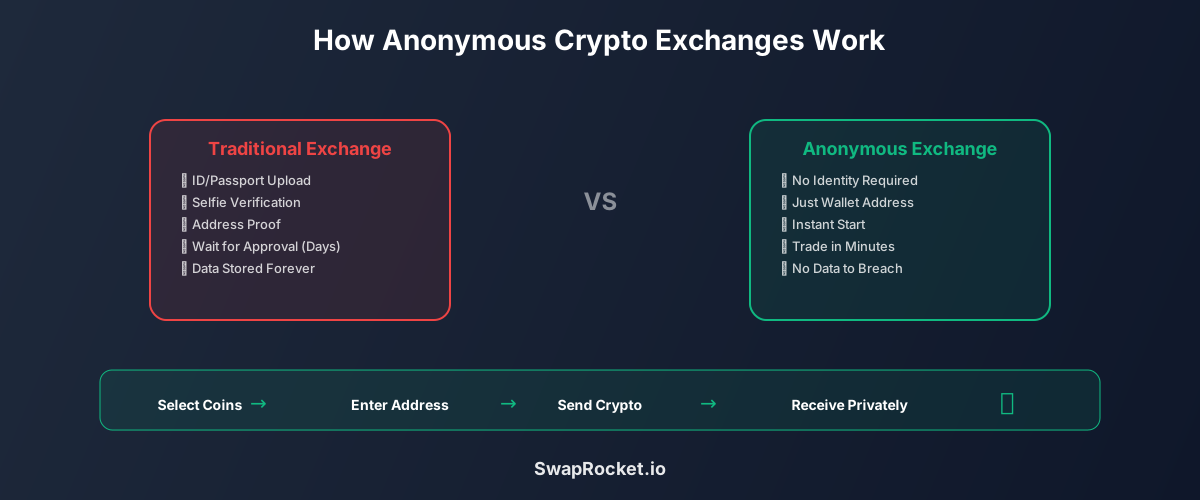
The flow is always the same:
- Choose the coin you send and the coin you want to receive.
- Enter the receiving address.
- Send your coins to the one-time deposit address you are shown.
- Receive the swapped coins in your wallet.
"Anonymous" is the word people search for, but "no-KYC" or "account-free" is the accurate description. The next two sections show why the difference matters.
Anonymous exchange vs account-based exchange
| No-KYC swap service | Account-based exchange | |
|---|---|---|
| Identity check | None for a standard swap; a flagged transaction can be held for verification | Required before you can trade |
| Account | None | Email, password, verified profile |
| Personal data stored | No identity file; the swap itself (addresses, amounts) is recorded | ID documents, address, often bank details |
| Custody | Coins go from your wallet to your wallet | Coins sit in the exchange's wallet until you withdraw |
| Waiting before first trade | None | Verification can take hours or days |
| Fiat (cards, bank transfers) | Not handled | Usually supported |
| Where it is offered | Varies by service; SwapRocket is not offered to residents of the United States or the United Kingdom | Varies by exchange and country |
What a No-KYC Exchange Does Not Hide
Being honest about the limits is what separates a useful privacy tool from a false promise.
- The blockchain is public. On Bitcoin, Ethereum, Solana and most other chains, anyone can see your deposit and the payout, including amounts and addresses.
- The swap is recorded. The service and its liquidity provider know the deposit address, the payout address and the amounts. What they do not have is your name or documents.
- Screening still happens. The licensed liquidity provider checks incoming transactions. Rarely, it holds one that looks high-risk and asks the sender for verification.
- Your network connection is visible to the sites you visit, like on any website.
So a no-KYC exchange removes the identity file and the account. It does not erase the trail your coins leave on-chain. For a closer look at that trail, see what your on-chain activity reveals.
Why People Exchange Crypto Without an Account
Less personal data in other people's databases
Account-based exchanges collect ID scans, selfies, home addresses and phone numbers. Customer databases at crypto companies have leaked before, and a leaked list of crypto holders with home addresses is a real-world safety problem. A service that never collects those documents has none to lose.
No waiting
There is no verification queue and no "pending approval". You can swap as soon as you have a receiving address.
No custodial balance
On a custodial exchange your coins are a number in someone else's database until you withdraw, and withdrawals can be paused. With a non-custodial swap the coins leave your wallet and arrive in your wallet, and nothing is parked in an account in between.
Privacy as a default
Paying in cash does not require showing ID, and wanting the same for an ordinary swap between two coins does not need a special reason.
How a No-KYC Swap Works, Step by Step
This is the flow on SwapRocket; most account-free swap services look similar.
- Open the exchange page. Type the address yourself or use a bookmark, and check the domain: swaprocket.io/exchange.
- Pick the pair. For example BTC to ETH, ETH to XMR or SOL to USDT.
- Enter the amount. You see an estimate of what you will receive. The rate is floating, so the final amount follows the market until your deposit is processed. The estimate already includes the service fee and the payout network fee; nothing is added afterwards.
- Paste your receiving address. Use a wallet you control, on the right network for the coin you are receiving. Some coins (XRP, XLM and others) also need a tag or memo.
- Send the deposit. You get a one-time deposit address. Send from your own wallet. You pay the network fee for that transaction, as with any transfer.
- Wait for confirmations. The deposit has to confirm on its own chain first. This is the slowest part: Bitcoin deposits take longer than deposits on faster chains.
- Receive the new coins. The liquidity provider executes the swap and pays out to your address. Start to finish is typically 5 to 30 minutes.
Save the swap ID. It is how you track the swap and how support finds it if you write to support@swaprocket.io.
Types of No-KYC Crypto Exchange
"Anonymous exchange" covers four different kinds of service, described here on the same points.
| Type | How it works | Accounts or ID | Good for | Watch out for |
|---|---|---|---|---|
| Swap service (SwapRocket is one) | You send coin A to a deposit address; a liquidity provider pays coin B to your address | No account; screening can flag a transaction | Simple swaps between coins on different chains | You rely on the service to execute; a floating rate is set when the deposit is processed |
| Decentralized exchange (DEX) | A smart contract trades tokens from your connected wallet | Wallet connection, no account | Tokens on the same chain | Gas costs, slippage, contract approvals, usually one chain at a time |
| Peer-to-peer (P2P) market | You trade directly with another person, usually with escrow | Varies by platform and by counterparty | Paying or being paid in cash or bank transfer | Slower, counterparty and scam risk, thinner liquidity |
| Cross-chain bridge | Locks a token on one chain and issues it on another | Wallet connection | Moving the same asset between chains | Bridge contract risk, wrapped assets |
How to Use a No-KYC Exchange Safely
- Verify the URL. Phishing copies of swap sites exist. Bookmark the real one and never follow a link from a direct message or an ad.
- Start small. On a service or pair you have not used before, run a small swap first.
- Receive into a wallet you control. A hardware wallet or a well-known software wallet whose recovery phrase only you hold.
- Match the network. USDT on Tron and USDT on Ethereum are different deposits. Check the network on both sides before you send.
- Judge the offer by what you receive. Compare the estimated amount you get, not headline fee claims.
- Keep the swap ID and the transaction hashes for your records and for tax reporting.
- Use fresh receiving addresses if you do not want separate swaps linked to one address.
The crypto swap safety checklist goes through each of these in more detail.
Anonymous Exchange vs Mixing Service
They are often confused and are not the same thing.
A mixer pools coins from many users and pays them back out to break the on-chain link between sender and receiver. Some mixers have been sanctioned or shut down, scam mixers are common, and coins that passed through one are often refused by other services.
A no-KYC exchange converts one coin into another. It does not pool or "clean" anything, and it does not claim to hide the transaction. The only thing it leaves out is the identity file.
Is an Anonymous Crypto Exchange Legal?
In most countries an individual is free to swap one cryptocurrency for another without opening a verified account. Identity rules are written for the businesses that provide financial services, and how they apply depends on the country and on the type of service. Rules differ and change, so check the ones where you live; some countries restrict crypto activity altogether.
Two things do not change with the service you use:
- Tax. In many countries a crypto-to-crypto swap is a taxable disposal. Using a no-KYC service does not remove the obligation to report it. Keep records and ask a tax professional if you are unsure.
- Availability. Services decide where they operate. SwapRocket is not offered to residents of the United States or the United Kingdom.
For the longer version, read Is a No-KYC Crypto Exchange Legal?
Privacy Coins: Exchanging to Monero
The swap service controls how much it knows about you. The coin controls how much the blockchain shows. On Monero (XMR), amounts, senders and receivers are hidden by the protocol itself (RingCT, ring signatures and stealth addresses), which is why people who care about on-chain privacy often exchange into it.
Keep the two layers apart in your head: the deposit you send from Bitcoin or Ethereum is still public on that chain, and the swap is still screened. What becomes private is what happens to the XMR after it reaches your wallet.
- Into Monero: BTC to XMR exchange, ETH to XMR exchange, SOL to XMR exchange
- Out of Monero: XMR to BTC exchange, XMR to ETH exchange, XMR to USDT exchange
How SwapRocket Fits
This is SwapRocket's own blog, so here is the plain description rather than a pitch.
- Crypto to crypto only, across 700+ assets. No cards, no bank transfers, no fiat payouts.
- No account and no email. No KYC for standard swaps; the liquidity provider can, rarely, hold a flagged transaction and ask for verification.
- Non-custodial. You send from your own wallet and the swapped coins go to the address you give. There is no wallet connection.
- One licensed liquidity provider executes each swap, at a floating rate. The estimate shown before you send includes the fee and the payout network fee.
- 5 to 30 minutes for a typical swap.
- Not offered to residents of the United States or the United Kingdom.
- Support by email at support@swaprocket.io.
To see how other services compare, read the comparison of no-KYC crypto exchanges. To start a swap, open the SwapRocket exchange or go straight to a pair: BTC to ETH, ETH to BTC, BTC to USDT, BTC to XMR.
Related Reading
- How to Swap BTC to XMR Without KYC
- ETH to XMR: Swap Ethereum to Monero
- Monero Bridge Guide
- No-KYC Crypto Exchange Guide
- SwapRocket FAQ
Frequently Asked Questions
What is an anonymous crypto exchange?
It is a crypto-to-crypto exchange that needs no account and no identity documents for a standard swap. You enter a receiving address, send your coins and receive the new ones. "No-KYC" is the more accurate name, because the transactions themselves are still public on-chain.
Is an anonymous crypto exchange really anonymous?
No. It does not collect your name or ID, but your deposit and payout are visible on public blockchains, and the liquidity provider screens transactions. A flagged swap can be held until the sender completes verification.
Is it legal to use a crypto exchange without KYC?
In most countries, individuals may swap crypto without a verified account, but rules vary and some countries restrict crypto altogether. Tax obligations on swaps apply regardless of the service. Check the rules where you live.
How long does a no-KYC swap take?
Typically 5 to 30 minutes on SwapRocket. Most of that is waiting for the coin you sent to confirm on its own blockchain, so a Bitcoin deposit takes longer than one on a faster chain.
What fees do I pay?
The estimate you see before sending already includes the service fee and the payout network fee, and nothing is added afterwards. Separately, your own wallet charges the normal network fee for the deposit transaction.
Can I exchange cash or card payments for crypto anonymously?
Not on a crypto-to-crypto exchange. SwapRocket does not handle cards, bank transfers or fiat payouts, and services that do handle fiat generally have to verify identity. A swap service is for exchanging a coin you already hold into another one.