On Bitcoin, Ethereum and most other chains, every transaction you make is public and permanent: amounts, timing, counterparties and the full history of each address. Your name is not on the ledger, but one link between an address and your identity, such as a deposit to an exchange that verified you, lets anyone read that history as yours.
Most people this happens to are doing nothing unusual. They pay for things, move funds between wallets, swap tokens and cash out now and then.
This guide explains what is visible, how analysts connect addresses, and which habits limit the exposure. Where swapping comes up, the examples use the SwapRocket crypto exchange, since this is SwapRocket's blog.
TL;DR
- Bitcoin and Ethereum are public ledgers. Transactions stay visible forever.
- An address is not an identity until one link is made. An exchange deposit, an ENS name, a social post or NFT activity can tie you to a whole cluster of addresses.
- Clustering works. Analysts infer which addresses share an owner from patterns such as change outputs on Bitcoin or shared funding sources on EVM chains.
- Stablecoins are easy to follow. USDT and USDC move on transparent ledgers and often pass through centralized services.
- Better privacy is mostly habit: separate wallets, fresh addresses, no single hub wallet.
- A swap without an account means fewer documents on file. It does not make you anonymous, and it does not erase on-chain history.
The Myth of the Anonymous Wallet
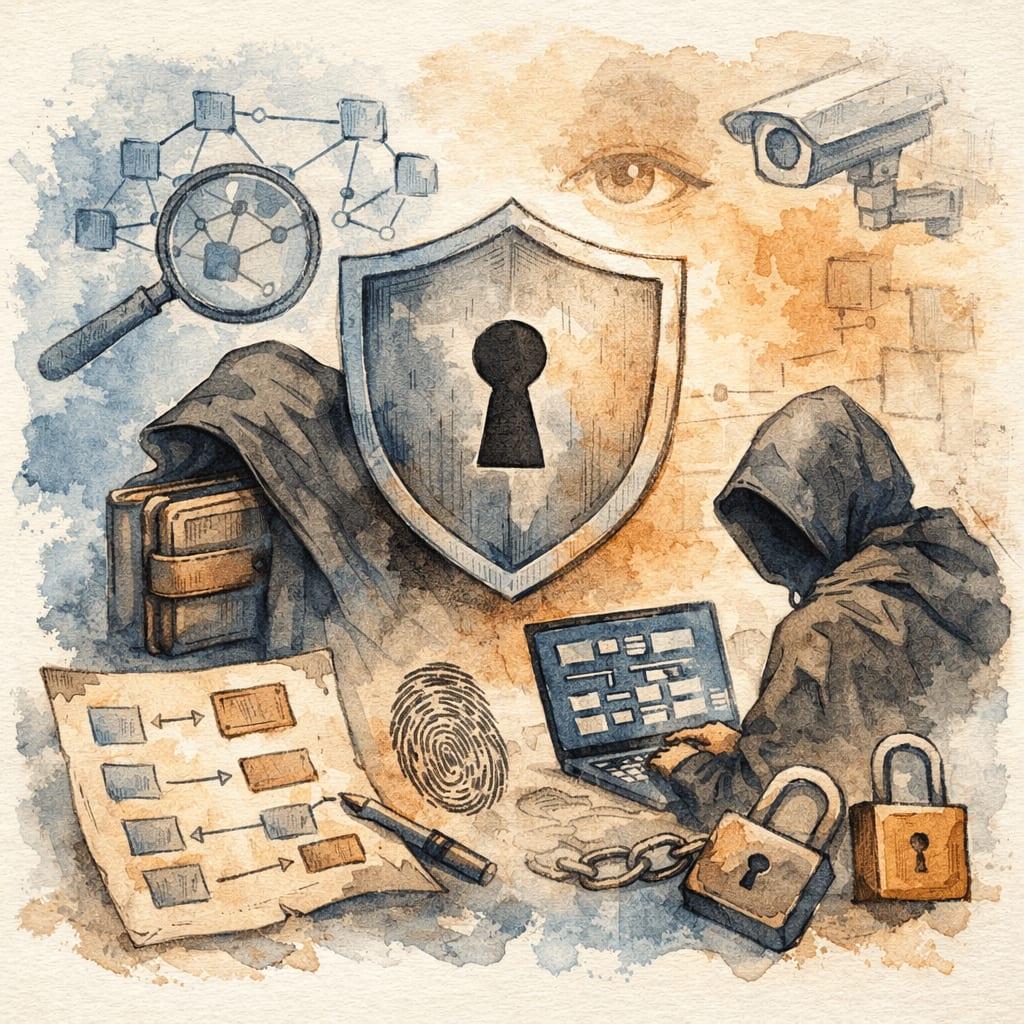
An address looks like random characters, with no photo, phone number or name attached, so it is natural to assume a wallet is anonymous. A better picture is a glass bank account. People may not know whose it is at first, but once they do, they can scroll through years of deposits, withdrawals, counterparties and amounts.
Example: one exchange withdrawal
Say you buy some ETH on a centralized exchange that has verified your identity and withdraw it to your own wallet. Later you swap part of it to USDT, send some to a friend, bridge some to another chain and buy an NFT.
Because the withdrawal is tied to your account, anyone with access to the exchange's records, and anyone who can label that withdrawal, can follow:
- the withdrawal address
- the addresses it goes on to interact with
- the assets you hold
- your usual transaction sizes and patterns
Nothing clever is involved. It is public data, and it accumulates.
What Your Transactions Reveal
Balances, present and past
On most chains anyone can see which tokens an address holds, how much, when they arrived and when they left. A large balance you once held remains visible in the history after it has gone.
Counterparties
Every transfer creates a link. If one side of it is already known, for example an exchange hot wallet, a payment processor or a public donation address, that label attaches to the graph around you.
Habits
People are patterned, and analysts look for:
- recurring transfers that look like salary
- round amounts versus irregular ones
- activity at consistent times of day
- "peel chains", where small portions are repeatedly sent out of a larger pot
No single pattern identifies you. Several together often do.
Network and device traces
This part is off-chain but matters. Wallets, dApps, RPC providers and block explorers can log IP addresses and browser details, and some of those services are tied to accounts or cookies.
How Blockchain Analysis Works

It is closer to what advertisers do than to hacking: build a graph, label the known points and infer the rest.
Transaction graphs
Every transfer is a relationship between addresses. Over time those relationships form a graph of addresses, transactions, assets, timestamps and smart contracts. Label a few nodes, such as a known exchange wallet, and much of the activity around them becomes readable.
Address tagging
Many identity leaks are simple tags:
- You deposit to an exchange that knows who you are.
- You publish a wallet address for donations.
- You use an ENS name that points to your profile.
- You sign a public message to prove ownership.
Once a tag exists, it stays.
Address clustering
Clustering means inferring that several addresses are controlled by one entity. The methods differ by chain.
Bitcoin and other UTXO chains. Bitcoin has no accounts. It has unspent outputs (UTXOs), which behave like banknotes in a wallet. When you spend, your wallet often combines several of them as inputs, and the common assumption is that all inputs to one transaction belong to the same owner, because spending them required all the keys.
Then there is change. As an example, if you pay 0.3 BTC from a 1 BTC output, about 0.7 BTC comes back to a change address you control. Analysts guess which output is the change from the address type, the amount and reuse. That is how an ordinary payment quietly links addresses together.
Ethereum and EVM chains. These are account-based, so the signals are different:
- a common funding source, such as several wallets funded by the same exchange withdrawal
- gas funding, where one wallet sends small amounts of ETH to several others
- identical sequences of dApp actions across wallets
- wallets that move at the same times
None is conclusive alone. Together they are strong evidence.
Smart contracts leave detailed footprints
Token approvals, swaps on decentralized exchanges, bridges, NFT mints and lending positions are all recorded. One DeFi session can expose more than ten simple transfers.
Everyday Privacy Leaks
Reusing one address
Receiving every payment at the same address publishes your income history to anyone who knows that address.
One wallet for everything
Salary, savings, DeFi, NFTs and donations in one wallet means a single link exposes all of it.
Assuming a bridge or swap resets history
Sometimes moving between chains does reduce linkability. Often it does not, especially when the same amount reappears on the other chain minutes later, when the amount is distinctive, or when everything ends up in the same destination wallet.
Stablecoins
Stablecoins such as USDT are useful for holding value, but they move on transparent ledgers through standard token contracts that are easy to monitor, and they often pass through exchanges and payment services. Treat a stablecoin transfer as a public receipt. A pair such as ETH to USDT is convenient for stepping out of volatility; it does not make the funds harder to follow.
Privacy Options and Their Tradeoffs
| Approach | What it helps with | What it does not do |
|---|---|---|
| Basic hygiene (new addresses, separate wallets) | Casual snooping and easy clustering | Requires discipline; does not hide a wallet once it is tagged |
| Swapping without an account | Keeps identity documents and an account history off one more platform | Deposits and payouts are still on-chain; the liquidity provider sees and screens the swap |
| Coin control (choosing which UTXOs to spend) | Clustering through combined inputs and change | Manual and easy to get wrong |
| Privacy coins such as Monero | Hides sender, receiver and amount on-chain | Fewer integrations; entry and exit points remain visible |
Practical Privacy Habits
Privacy is a slider, not a switch. These habits do the most for the least effort.
1. Separate wallets by purpose
- Vault wallet: long-term holdings, rarely used
- Spending wallet: daily activity, small balances
- DeFi or NFT wallet: public, higher-risk activity
If the public wallet gets linked to you, the vault stays out of the picture, as long as the two never transact directly.
2. Move only what a task needs
A single wallet holding everything is convenient for you and for anyone watching. Keep the bulk elsewhere and fund a task with what it requires.
3. Understand what timing and amounts give away
An identical amount leaving one address and arriving at another a few minutes later is easy to match, with or without a swap in between. You do not need to behave strangely to account for this. You only need to stop assuming that a swap or a bridge makes two wallets unrelated.
4. Hand over identity documents only where they are needed
Much privacy loss happens off-chain, at the moment a platform collects a passport scan, a selfie, an address and a login history, and stores them where a breach can expose them.
A coin-to-coin swap on SwapRocket needs no account or email, and there is no KYC for standard swaps. You send from your own wallet and the swapped coins go to the address you give. Two limits apply: the licensed liquidity provider that executes the swap screens transactions and can, rarely, hold a flagged one and ask for verification, and SwapRocket is not offered to residents of the United States or the United Kingdom.
5. Consider a privacy coin where confidentiality matters
Journalists, activists, businesses paying salaries and people who simply do not want their net worth public have good reasons to want more than hygiene. Monero (XMR) hides sender, receiver and amount by default. Is Monero traceable? covers how that works and where it leaks. The usual way in is an exchange such as BTC to XMR; other pairs are on the Monero (XMR) price and pairs page.
6. Do not confuse privacy with security
- Security stops theft: hardware wallets, backups, avoiding scams.
- Privacy limits who can see your activity.
You can be secure and fully exposed, or private and careless with your seed phrase. Aim for both.
None of this is about hiding from obligations. Swaps are taxable events in many countries, and good records are part of good practice.
What Analysts Can Infer From Normal Activity
A stablecoin salary
You are paid in USDT on a public chain. An observer who knows the address can infer your pay schedule, your approximate income and your larger regular payments. If you then send that USDT to an exchange account in your name, the link to you is complete.
A cross-chain conversion
You move from SOL to ETH whenever markets turn volatile, using something like the SOL to ETH exchange. If the pattern is always the same amounts into the same destination wallet, someone watching your Solana address can usually follow the story onto Ethereum.
A public NFT wallet
People share NFT wallets openly. If that wallet transacts even once with the wallet holding your savings, your public persona and your holdings are connected.
Why Privacy Matters When You Have Nothing to Hide
- Personal safety: visible wealth attracts the wrong attention.
- Business confidentiality: suppliers, payroll and treasury flows are valuable information to competitors.
- Negotiation: a counterparty who can see your holdings has an advantage.
- Permanence: the ledger does not forget, and what seems harmless now may read differently later.
The aim is choice over what you disclose, not secrecy at any cost.
Privacy Checklist
- Use separate wallets for savings and for activity.
- Do not reuse addresses where you can avoid it.
- Do not route everything through one hub wallet.
- Remember that timing and exact amounts link transactions across chains.
- Treat stablecoin transfers as public receipts.
- Keep your long-term wallet's activity minimal.
- Give identity documents only to services that need them.
- Keep your own records for tax purposes.
For the practical side of moving funds between chains, see the privacy-first crypto playbook.
Frequently Asked Questions
Can people see my name on the blockchain?
Not directly on most chains. They see address activity. Your name comes in when an address is linked to you through an exchange account, a public post, an ENS name, a merchant tool or another data source.
If I use a new address, am I private?
More than before, but not fully. Clustering and behavioral links can still connect a new address to old ones, especially when it is funded from the same source in an obvious way.
Do swaps make my funds private?
A swap can reduce linkability, but it does not erase history. If the swap is easy to correlate by amount, timing or destination wallet, the two sides can still be connected, and the service that executed it has a record.
Are stablecoins like USDT traceable?
Yes. USDT and USDC transfers are recorded on public ledgers through standard token contracts, which makes them some of the easiest assets to follow at scale.
What is the most private way to transact on-chain?
Designs built for privacy, such as Monero, hide far more than transparent ledgers do. How much you need depends on your situation and on how much complexity you are willing to manage.
Is a swap without KYC legal?
In most countries, using one is legal for individuals, though rules differ. See Is a no-KYC crypto exchange legal? for the detail, and how no-KYC exchanges work for the mechanics.
Related Reading
- Privacy-first crypto playbook
- Is Monero traceable? How XMR privacy works
- Non-custodial vs custodial exchanges
When you next need to exchange one coin for another, you can do it wallet to wallet on the SwapRocket exchange. Check the estimate on the pair page first, and see the FAQ if anything is unclear.