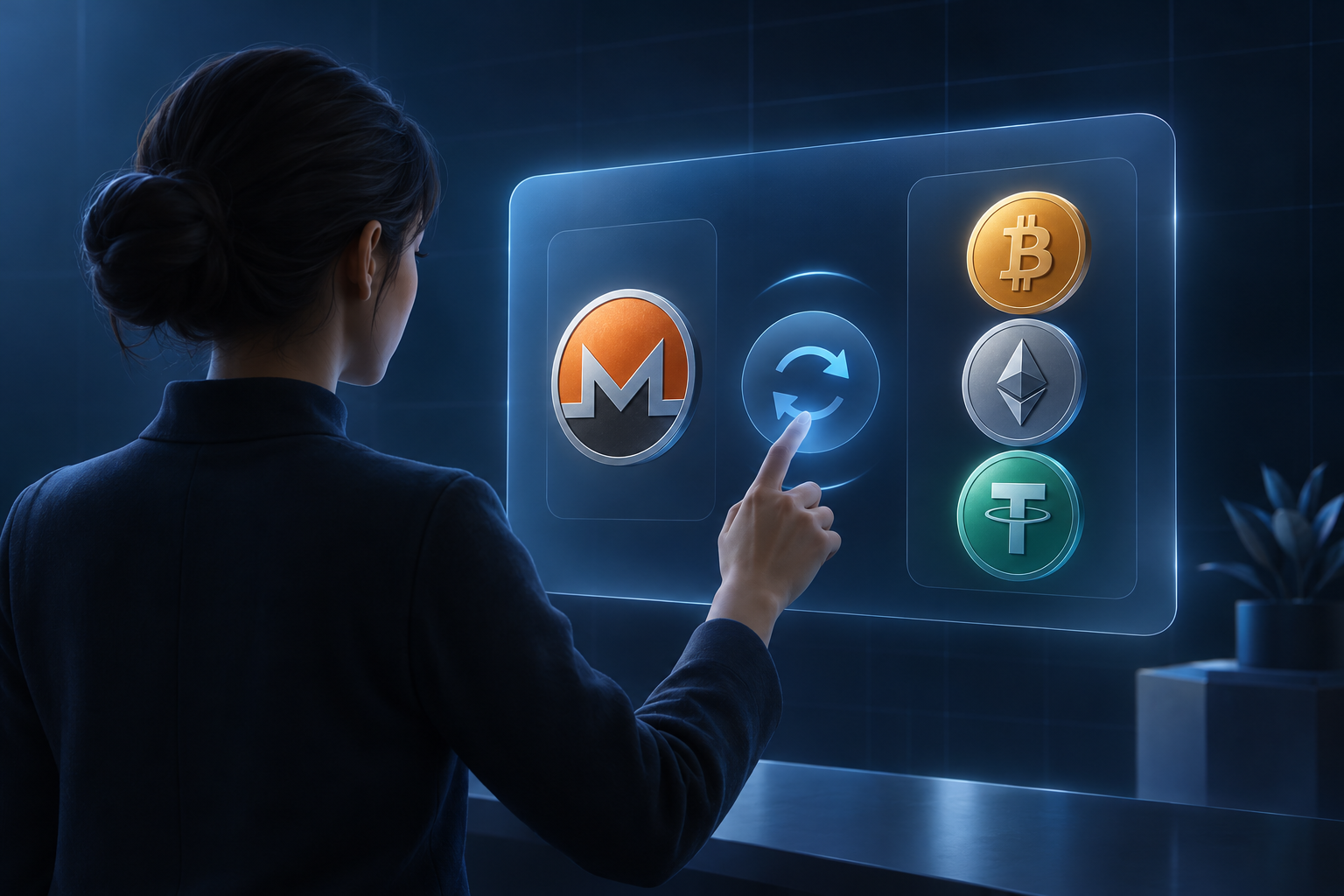
To exchange Monero on SwapRocket, open the XMR to BTC exchange, the XMR to USDT exchange or the XMR to ETH exchange, send XMR from your own wallet and receive the other coin at an address you control. If you searched for how to sell Monero: here that means exchanging XMR for another cryptocurrency. SwapRocket does not pay out to a bank account or a card.
Standard swaps need no account, email or identity documents. The licensed liquidity provider that executes the swap screens transactions and can, rarely, hold a flagged one and ask for verification, so no-account swapping is not a promise of anonymity.
- Exchanging XMR here means swapping it for BTC, ETH, USDT or another coin. It does not mean withdrawing cash.
- You need the Monero wallet that holds your XMR and a compatible address for the coin you want to receive.
- SwapRocket does not hold your funds; they go from your wallet to the liquidity provider and back to your wallet.
- The rate is floating, and the displayed estimate already includes the exchange fee and the payout network fee.
- Check the pair direction, payout network, live limits and refund address before sending.
How does a Monero exchange work without an account?
On an account-based exchange you typically deposit XMR into a platform balance, trade it there and withdraw the proceeds. With a wallet-to-wallet swap there is no platform balance: you send XMR for one particular transaction and receive the output coin at the address you chose.
SwapRocket is a non-custodial swap service: funds move from your wallet to the liquidity provider and back to your wallet. SwapRocket does not hold them, but the provider still handles the exchange, so non-custodial does not mean there is no intermediary or transaction risk.
What you cannot do here is turn XMR into dollars, euros or any other bank money. If your aim is to hold a dollar-pegged value, XMR to USDT is the closest route, and what you receive is still a crypto token in your own wallet. For the opposite direction, see the no-KYC Monero exchange guide.
Which coin should you exchange XMR for?
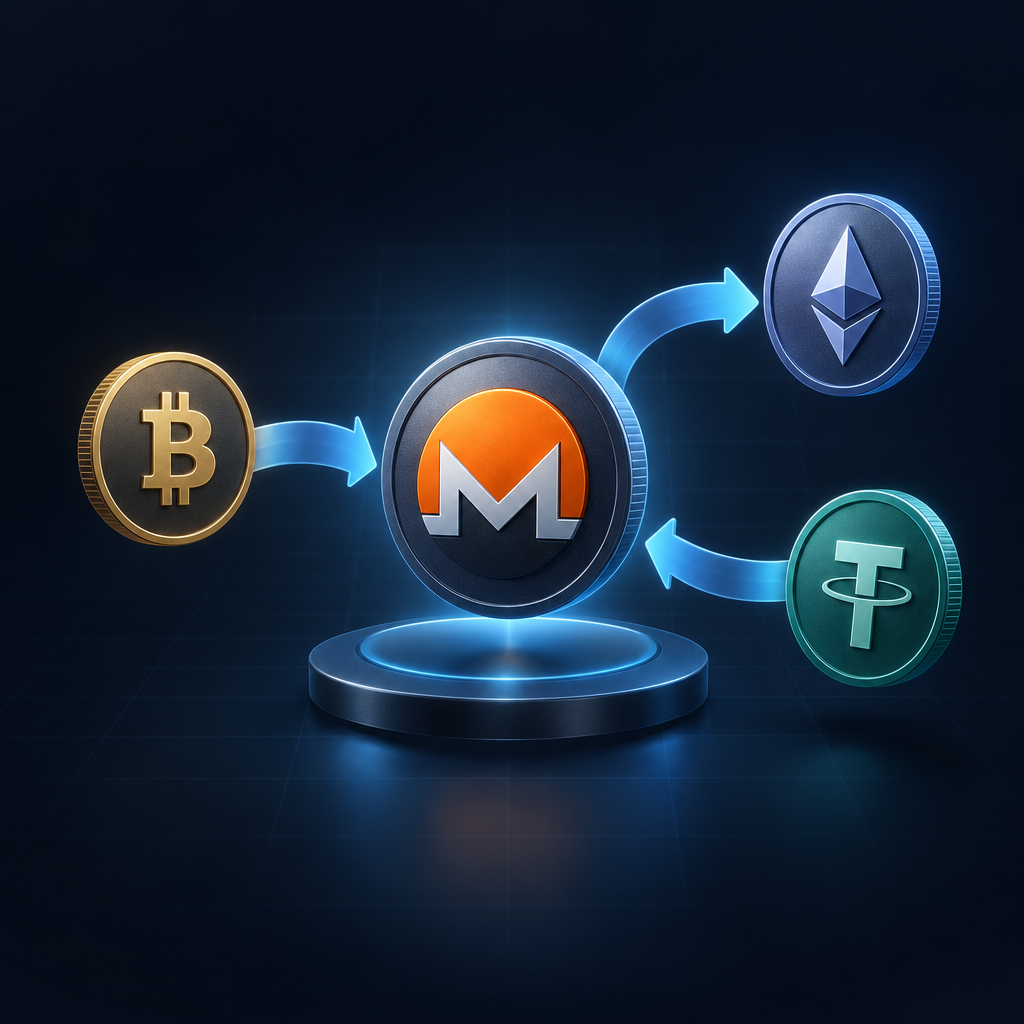
The pair direction tells you which asset leaves your wallet and which asset arrives. In these routes XMR is always the coin you send. Every XMR pair, in both directions, is linked from the Monero (XMR) exchange page.
| Route | You receive | Destination wallet requirement | Main check |
|---|---|---|---|
| XMR to BTC | Bitcoin | Bitcoin receiving address | Confirm the address belongs to your intended Bitcoin wallet |
| XMR to ETH | Ether | Ethereum receiving address | Confirm the payout network, not just the address format |
| XMR to USDT | Tether | USDT-compatible address on the selected network | Confirm your wallet supports USDT on that network |
USDT requires particular care because the same ticker exists on multiple blockchains. USDT on Ethereum and USDT on TRON are separate assets, even though both display as USDT, so the payout network you select has to be one your receiving wallet supports.
SwapRocket supports 700+ assets, which you can explore in the supported cryptocurrency list. Each pair page shows its live rate, minimum and maximum; check those details rather than relying on an old screenshot or guide.
What do you need before you exchange XMR?
You need two wallets: the Monero wallet that holds your XMR, and a wallet for the coin you will receive. A Monero address cannot receive BTC, ETH or USDT, so the destination has to be an address for the output coin on the right network.
These are common Monero wallets you might be sending from:
| Wallet | Typical fit | Before you send |
|---|---|---|
| Monero GUI | Desktop users who want the Monero project's graphical wallet | Let the wallet finish synchronizing with its node |
| Feather Wallet | Desktop users who prefer a lightweight Monero-focused wallet | Check that the balance shows as unlocked |
| Cake Wallet | Mobile users who hold Monero alongside other supported assets | Make sure the Monero wallet, not another asset, is selected |
Let the wallet synchronize before you start, and check that the XMR you plan to exchange is spendable. Recently received Monero stays locked for 10 blocks, about 20 minutes, so a balance can be visible before all of it can be sent.
Keep your recovery information offline, and never enter it into a swap form or send it to support. A receiving address is not a recovery phrase: sharing an address lets someone send you funds, while sharing the phrase can give them control of your wallet.
How to exchange Monero for BTC, ETH or USDT step by step
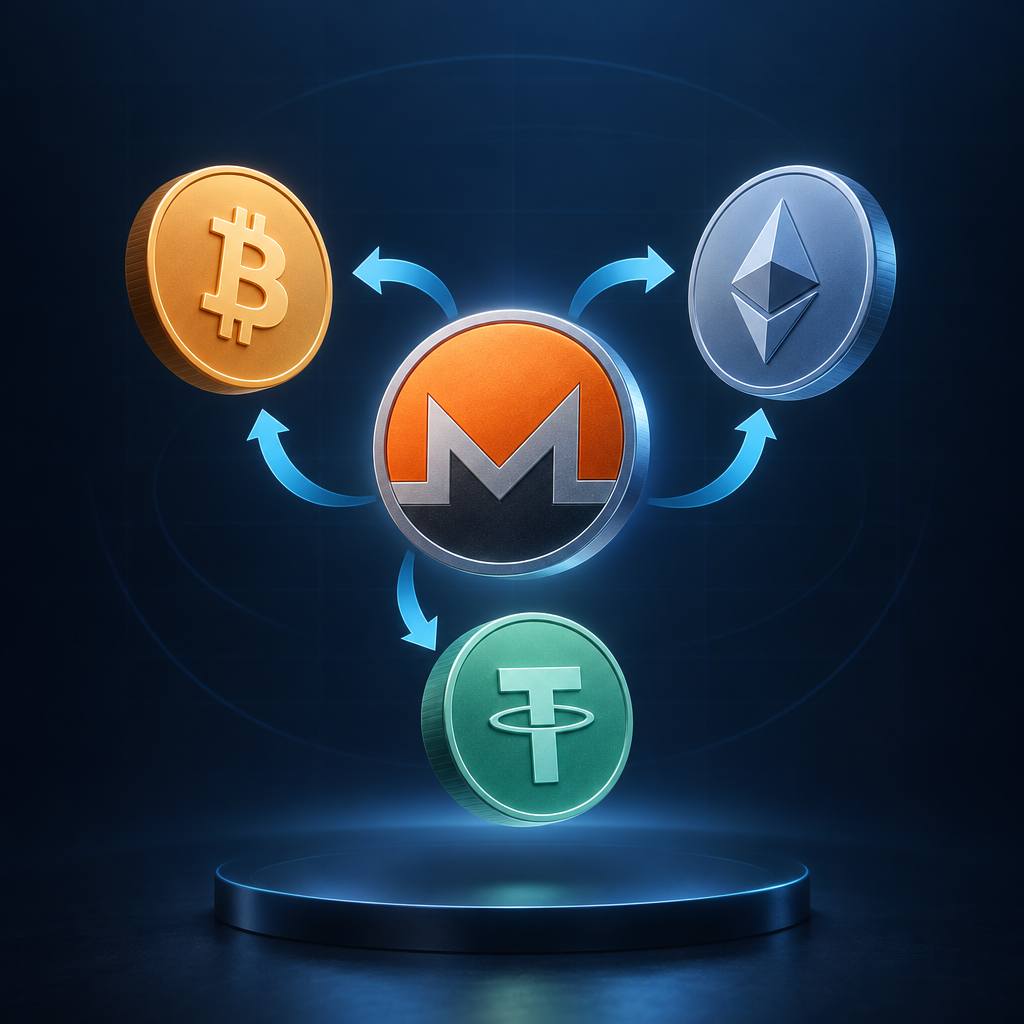
The process is the same for all three routes. Have the receiving address for the output coin and a Monero refund address ready before starting.
- Open the correct pair. Use XMR to BTC, XMR to ETH or XMR to USDT from the table above, with XMR as the coin you send.
- Enter the amount of XMR you want to exchange. Check the live minimum and maximum for that pair. Leave enough XMR in your wallet to cover the Monero network fee for sending the deposit.
- Confirm the payout network. For USDT, choose the network your receiving wallet supports. Do not assume every USDT network is available for your chosen route.
- Enter your receiving address. Copy it from the destination wallet and compare it again after pasting. SwapRocket validates the address against the target network before the swap can start.
- Provide a refund address. Use a Monero address you control. A valid refund address does not guarantee an immediate refund if a transaction encounters a problem.
- Review the estimate and send as instructed. The rate is floating, so the estimated output can change. Send XMR to the deposit address shown for this swap, in the amount shown.
- Check your receiving wallet. Keep the sending transaction ID so you can identify the transfer if needed. Wait for any confirmation requirements on the receiving network before treating the output as ready to spend.
What should you check before you send XMR?
The most expensive mistakes are often network or address mistakes, not a slightly worse exchange rate. Address validation helps catch incompatible destinations, but it cannot establish that you own an address or copied the intended recipient.
- Asset and direction: Confirm that XMR is the coin you send and that the coin you receive is the one you want.
- Payout network: Match the receiving side to your wallet, especially when USDT is involved.
- Address ownership: Compare the pasted address with the one displayed in your wallet, ideally on a trusted device screen where available.
- Gas on the receiving side: Receiving USDT on Ethereum needs no ETH, but moving it later does. Plan for that before you choose the network.
- Refund destination: Avoid a Monero address you cannot access.
- Recovery phrase security: No legitimate swap step needs your wallet's seed phrase or private keys.
If you choose a small test swap, check that it meets the live minimum and remember that it incurs its own costs. A successful test reduces uncertainty about your setup, but it does not lock the rate or conditions for a later swap.
What does it cost to exchange Monero?
SwapRocket uses a floating market rate and does not offer a fixed-rate option. The estimate shown before you send already includes the exchange fee and payout network fee, so those included costs should not be subtracted a second time.
Your Monero wallet's transaction fee for sending the deposit is separate from that payout estimate. Compare what leaves your wallet, including that sending fee, with the estimated amount that reaches your destination rather than comparing headline rates alone.
Example: Suppose you enter 2 XMR as the amount to exchange for USDT. The pair page provides an estimated USDT payout after its included exchange and payout fees, while your Monero wallet shows the separate cost of sending the deposit. Because the rate floats, the final USDT amount can differ from the earlier estimate.
How long does an XMR exchange take?
A SwapRocket swap typically takes 5 to 30 minutes, with timing determined mostly by how quickly the deposited XMR confirms. This is a typical range, not a deadline or guarantee. Network congestion, a deposit that confirms slowly or a verification review can extend the process.
Your receiving wallet may also need time to show the incoming coin. Seeing a received balance and being able to spend it are not always the same moment, so check the wallet's transaction details.
Frequently Asked Questions
Can I exchange Monero without KYC?
Standard SwapRocket swaps require no account, email or identity documents. The licensed liquidity provider screens transactions and can, rarely, hold a flagged one and ask for verification, so you should not assume every swap will remain verification-free.
Can I sell Monero for cash or to a bank account?
Not on SwapRocket. It is a crypto-to-crypto service, so XMR can be swapped for BTC, ETH, USDT or another supported coin, and the payout goes to a crypto wallet. Turning that coin into bank money is a different service with its own requirements.
Which is better to exchange XMR for: BTC, ETH or USDT?
It depends on what you plan to do next. BTC and ETH keep you exposed to the price of those coins, while USDT is designed to track the US dollar. Choose the coin and the network that your receiving wallet supports.
Can I receive USDT on any network?
No: choose a payout network that both the swap route and your receiving wallet support. The USDT ticker alone is not enough to identify the correct blockchain, and funds sent to a wallet that does not support that network can be difficult or impossible to recover.
Is exchanging Monero through a swap anonymous?
No service should promise that. Monero provides privacy protections on its own blockchain, but the BTC, ETH or USDT you receive arrives on a public ledger, and a transaction can be flagged for review.
What if my BTC, ETH or USDT has not arrived?
First check whether your XMR deposit has confirmed. Then confirm that you entered the intended receiving address and network, keep the sending transaction ID, and never share your recovery phrase when seeking help.
Exchange XMR from your own wallet
If you hold XMR and want Bitcoin, open the XMR to BTC exchange to check the live rate, limits and estimated payout. Prepare your Bitcoin receiving address and a Monero refund address, then review the transaction before sending.
Related guides