A Monero subaddress is an additional receiving address derived from the same wallet keys, so you can receive XMR without sharing your primary address. On Monero mainnet, a subaddress starts with "8" and has 95 characters; it is the recommended receiving address for a swap into your own wallet. You can swap BTC to XMR on SwapRocket and have the XMR sent to the Monero address you provide, without connecting your wallet.
Key points
- Mainnet primary addresses start with "4" and contain 95 characters.
- Mainnet subaddresses start with "8" and contain 95 characters.
- Mainnet integrated addresses start with "4" and contain 106 characters, including an embedded short payment ID.
- A Monero subaddress does not need a separate payment ID.
How does a Monero subaddress work?
A Monero subaddress is an extra receiving destination controlled by the same wallet, not a new wallet with a new seed. Creating a subaddress is a local wallet operation that does not itself publish an address on-chain or require a transaction fee.
A subaddress is not the one-time output address recorded in a Monero transaction. The sender's wallet uses the receiving address and transaction cryptography to create a one-time destination for the output, which your wallet detects while scanning the blockchain.
You can give different subaddresses to different senders or use a new one for each incoming swap. Your wallet recognizes payments to those subaddresses and lets you spend the received XMR using the same wallet keys.
All three address formats in this guide receive native Monero (XMR), rather than a wrapped token on another chain. Subaddresses reduce exposure from reusing the same public receiving address, but other information can still link payments to you; see how Monero privacy works and where it leaks.
How can you tell Monero address types apart?
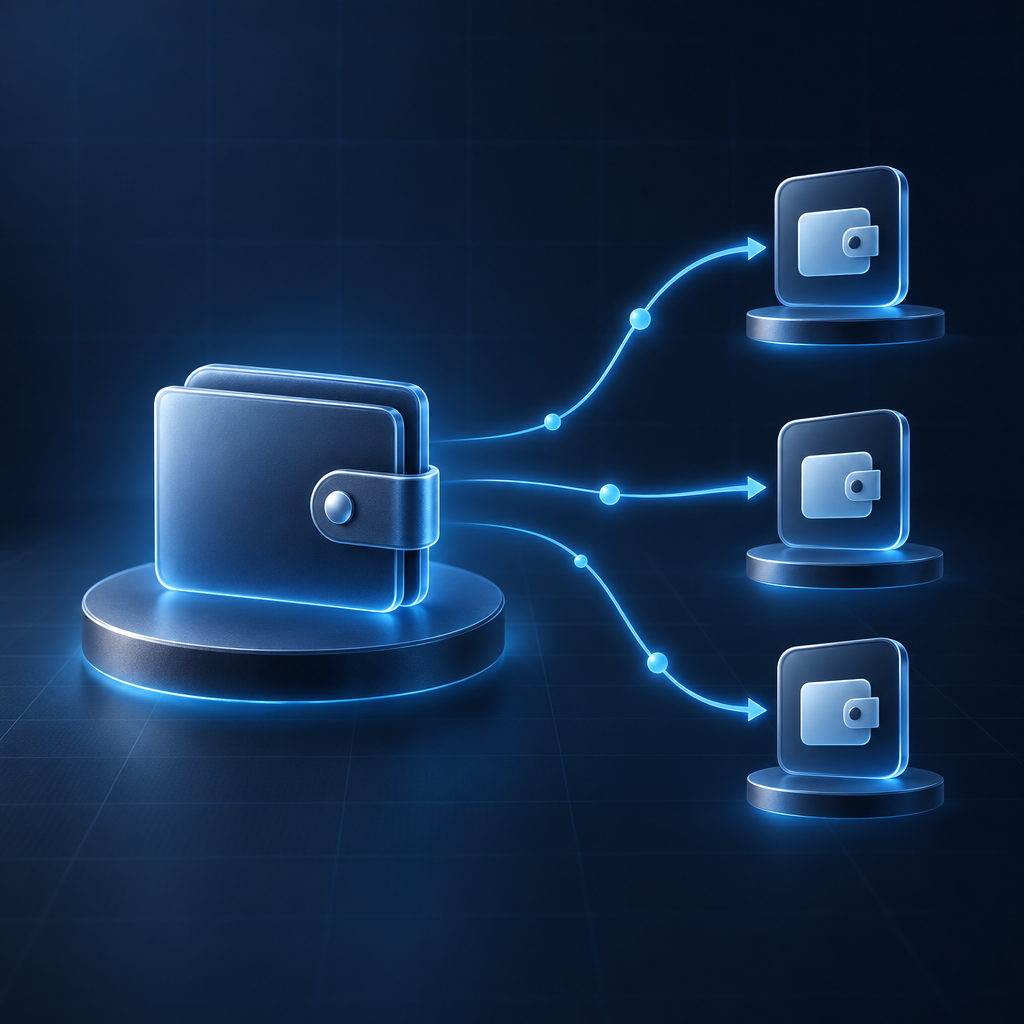
Monero mainnet address types can be distinguished by their first character and total length. Those checks identify the expected format, but they do not establish that an address is valid or belongs to the intended recipient.
| Address type | First character on mainnet | Length | What it contains | Typical purpose |
|---|---|---|---|---|
| Primary address | "4" | 95 characters | The wallet's primary public spend and view keys | The wallet's original receiving address |
| Subaddress | "8" | 95 characters | Public keys derived for an additional receiving destination | Separating payments by sender or purpose |
| Integrated address | "4" | 106 characters | A standard address plus an embedded short payment ID | Identifying a payment in systems that use integrated addresses |
The prefix and length rules above apply to Monero mainnet, not its test networks. Both primary and integrated addresses start with "4", so checking only the first character cannot distinguish them.
Monero addresses include a checksum, which software uses to detect many input mistakes. A valid checksum does not prove ownership: copy the whole address from your wallet and compare it with the destination shown in the swap form.
Why were Monero payment IDs retired?
Monero retired the old standalone, unencrypted payment ID workflow because it exposed payment-label metadata and was easy to get wrong. Subaddresses let a recipient distinguish incoming payments by the receiving address instead of asking the sender to supply a separate identifier.
Historically, a service using one receiving address for many customers could ask each sender to attach a payment ID. If the sender omitted or mistyped the ID, the coins could reach the service while the service lacked the information needed to credit the right customer.
The important qualification is that not every kind of payment ID disappeared. Legacy long IDs were 32-byte, 64-hex-character values; integrated addresses embed a short 8-byte, 16-hex-character ID that is encrypted in the transaction.
Integrated addresses therefore remain a distinct Monero address format, even though subaddresses are the usual recommendation for ordinary receiving. When someone says "Monero payment IDs were retired", that should not be read as a claim that integrated addresses no longer exist.
How do you create a Monero subaddress?

In a subaddress-capable Monero wallet, open the receiving-address controls and create or select a new subaddress. You do not need to move XMR, create another seed, or pay a network fee to make one.
- Open the correct Monero wallet. Make sure you are using a mainnet XMR wallet rather than a test wallet or an address for a wrapped asset.
- Choose the account and open Receive. If your wallet supports multiple accounts, select the account where you want to organize the payment before choosing a receiving address.
- Create or select an unused subaddress. Depending on the wallet, the control may say "New address", "Create address", or appear in an address list; add a local label if that helps your records.
- Copy the complete address. Check that the mainnet subaddress starts with "8" and contains 95 characters, and never shorten or manually edit it.
Common wallets expose these controls differently, and menu labels can change between versions. Use the following as a navigation guide rather than an exact button-by-button script.
| Wallet | Where to look | What to select or create |
|---|---|---|
| Monero GUI | The Receive page for the selected account | Create an additional receiving address and optionally label it |
| Feather Wallet | The Receive tab and receiving-address list | Select an unused subaddress or use the available address controls |
| Cake Wallet | Receive inside your Monero wallet, then the address or subaddress controls | Select or create a subaddress for that XMR wallet |
Creating an address and detecting an incoming payment are separate operations. Your wallet still needs to synchronize and scan the relevant blockchain data before it can display the received XMR.
Which Monero address should you use for a swap?
For a swap that pays XMR into your own wallet, use a fresh mainnet Monero subaddress copied from that wallet's Receive screen. A primary address is also a valid Monero receiving address, but using it repeatedly gives every counterparty the same address string.
You normally do not need an integrated address for a personal-wallet payout. Do not generate or append a payment ID merely because another cryptocurrency uses a memo or destination tag.
- Put the XMR address in the receiving field. The refund address belongs to the deposited asset's network, which is Bitcoin for a BTC-to-XMR swap, so the two fields serve different purposes.
- Check the address after pasting. SwapRocket checks receiving addresses against the target network before a swap can start, but that check cannot establish who controls a valid destination.
- Do not supply a separate payment ID for your own subaddress. If you are instead receiving at a custodial service that supplies an integrated address or special deposit instructions, follow those instructions and confirm compatibility before sending.
SwapRocket is non-custodial: you send from your own wallet, the swapped coins go to the address you give, and SwapRocket does not hold a balance for you. SwapRocket is not offered to residents of the United States or the United Kingdom.
How do you manage and restore Monero subaddresses?
A Monero wallet's recovery seed can regenerate its deterministically derived subaddresses, but a restored wallet still needs to scan the relevant accounts and address indices to find their payments. Keep your wallet backup and useful address labels so you can identify which destination you gave to each sender.
A local label such as "BTC swap" is for your own records; it is not a payment ID to send with the transfer. A seed alone generally does not restore labels or notes, so use your wallet's backup features if that organization matters to you.
If a restored wallet does not show an expected subaddress payment, check its restore height and subaddress discovery settings before assuming the funds are gone. Recreate the relevant account and address range if your wallet requires it, then rescan according to that wallet's instructions.
Receiving XMR requires sharing the receiving address, not your seed or private keys. Never provide recovery material to a sender or enter it into a swap form to "activate" a subaddress.
Frequently Asked Questions
Monero subaddresses can be reused, remain valid, and do not require separate payment IDs. Subaddresses change how you share a receiving destination, not Monero's transaction confirmation rules.
Can I reuse a Monero subaddress?
Yes, a Monero subaddress can receive multiple payments. Using a fresh subaddress for a different sender or purpose avoids giving those counterparties the same receiving address and makes incoming payments easier to organize.
Do Monero subaddresses expire?
Monero subaddresses have no protocol expiry date. Creating a newer subaddress does not invalidate an older one, and the wallet controlling the corresponding keys can still recognize and spend payments sent to it.
Can I delete a Monero subaddress?
A wallet may let you hide an address or remove a local label, but those interface changes do not invalidate the Monero subaddress. Treat a subaddress you have shared as a destination that may continue to receive payments.
Can I send XMR from a subaddress?
You can spend XMR received at a subaddress using the wallet that controls it. A Monero transaction does not publish that subaddress as a transparent "from" address, so sending XMR is not equivalent to exposing a conventional sender-address field.
Does a Monero subaddress need a payment ID?
A Monero subaddress does not need a separate payment ID to receive XMR. Copy the address exactly as your wallet provides it, without appending an identifier or inventing a value for a memo field.
Does a subaddress make XMR arrive faster?
A Monero subaddress does not change transaction confirmation or spendability rules. For the separate waiting period after receipt, see Monero's confirmations and 10-block lock explained.
Create a fresh subaddress in your Monero wallet and copy the complete address. When you are ready to exchange, open the BTC to XMR exchange and enter that subaddress as your XMR receiving address.
Related guides