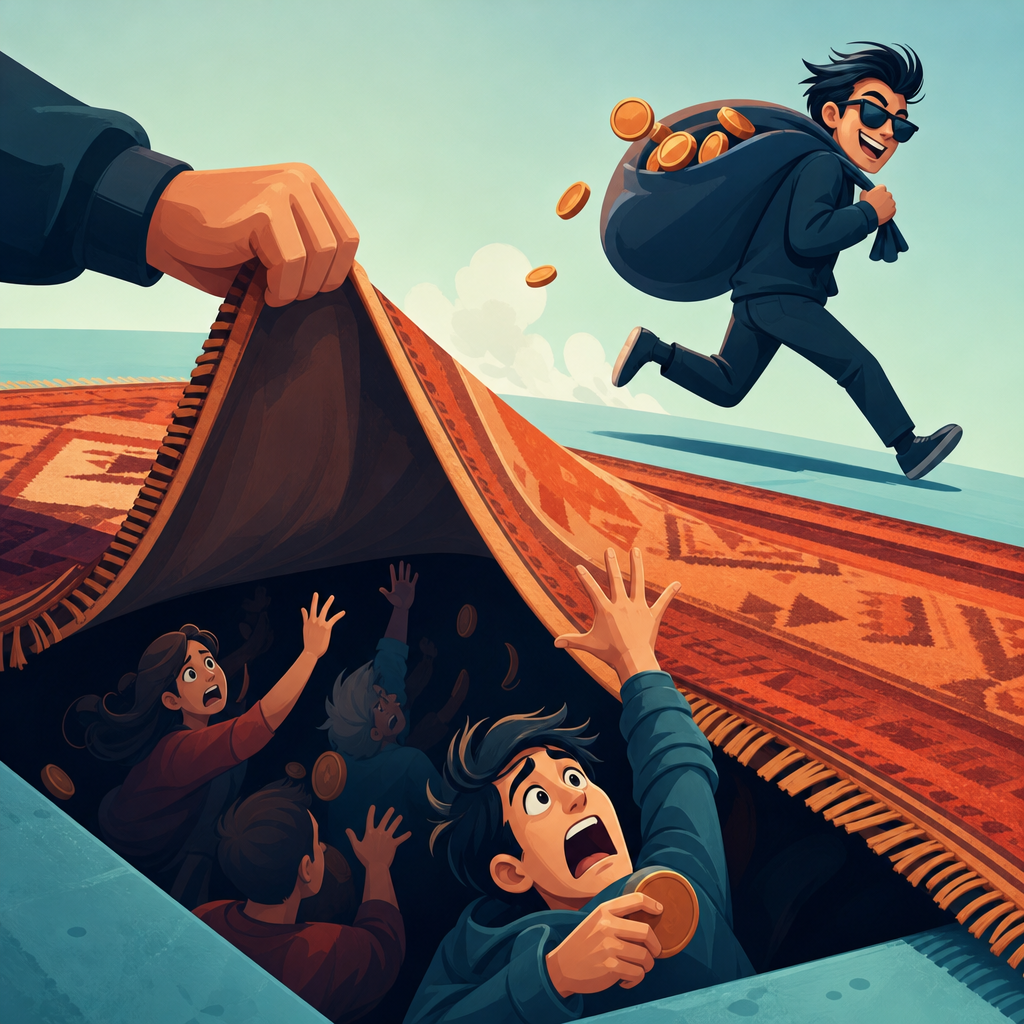
A rug pull is a crypto scam in which a token's creators or early insiders take the money out and leave later buyers holding something worthless. They usually do it by draining the liquidity pool, by blocking sells, or by dumping a large hidden allocation.
It differs from a project that simply fails: in a rug pull the token is built so that insiders can exit and you cannot. The defense is a short, repeatable check before you swap into any new token.
This is SwapRocket's blog. The SwapRocket crypto exchange swaps between established coins, which is a different activity from buying a newly launched token on a DEX, and the checklist below is for the second.
- A rug pull is when insiders extract the value from a token, most often by removing liquidity or blocking sells.
- The main warning signs are unlocked liquidity, owner controls, sell restrictions and adjustable token taxes.
- Before you swap, check: liquidity lock, contract ownership, a small sell test, holder distribution, tax rules and the project's track record.
- If you cannot verify that you will be able to sell, do not buy.
How a Rug Pull Feels From the Inside
As an illustration: you swap a small sum into a new meme coin on a DEX, and within minutes your wallet shows a multiple of what you put in. You try to take profit and the transaction fails. You raise the gas and try again. It fails again, and the chart falls to almost nothing.
Most rug pulls are not a slow leak. They are over in minutes.
How a Rug Pull Works

There are three common patterns.
1. Liquidity rug
A token trades on a DEX against a pool, for example Token/ETH. Whoever holds the pool's LP tokens can withdraw that liquidity. If the team holds them and they are not locked, the team can remove the ETH side at any moment. With nothing left to trade against, the token's price collapses.
2. Honeypot
The contract lets anyone buy, but sells fail for everyone except wallets on a whitelist, which belong to the developers. A variant lets sells go through but applies a sell tax so high that almost nothing comes back.
3. Slow rug
The team does not pull liquidity. It holds a very large share of the supply and sells it gradually while the social channels stay upbeat. The price bleeds out over days or weeks.
Rug pull vs pump-and-dump vs a project that failed
Not every ugly chart is a rug pull.
| Scenario | What it looks like | The telltale sign |
|---|---|---|
| Rug pull | Sudden crash, sells failing, liquidity gone | Insider control over the pool, the contract or a whitelist |
| Pump-and-dump | Sharp rise then sharp fall, trading still works | Coordinated hype, no liquidity removal |
| Failed project | Gradual decline, development stops | No malicious mechanics, only no traction |
Well-Known Rug Pull Examples
Squid Game token (2021): buyers could not sell
A token themed on the Netflix series rose very quickly. Reports at the time described holders being able to buy but not sell, and the price then fell to near zero.
Lesson: test that you can sell, with a tiny amount, before you commit anything meaningful.
AnubisDAO (2021): funds gone within a day
AnubisDAO raised a reported tens of millions of dollars in ETH from the public in a very short sale, and the funds were moved out soon afterwards.
Lesson: an anonymous team is not automatically a scam, but a brand-new, unaudited project that collects large sums in hours gives you no protection at all.
Copy-paste meme tokens
Low-fee chains regularly see waves of meme tokens that launch, trend and disappear within hours. The same features keep turning up: unverified contracts, a "team" that exists only in a chat group, unlocked liquidity and taxes changed after launch.
Lesson: in a fast meme cycle the useful skill is not finding the next winner. It is not getting trapped.
The Pre-Swap Rug Pull Checklist
You do not need to be a developer. You need to be methodical, and it takes about ten minutes.
Step 0: Set your risk budget
Decide how much you can lose in full before you look at a chart. For a brand-new token, experienced traders keep the first position small relative to what they can afford to lose.
Step 1: Check liquidity and whether it is locked
Liquidity is the depth you will need when you sell.
- Is it meaningful? In a thin pool, one medium-sized sell moves the price sharply.
- Is it locked? Unlocked liquidity, or a lock that expires in days, is a serious warning.
Look for a lock lasting months that you can verify on-chain or through the locking service itself. A screenshot is not proof.
Step 2: Check contract ownership and owner powers
Many rug pulls are owner privileges used at the worst moment. Warning signs:
- The owner can pause trading
- The owner can blacklist wallets
- The owner can change taxes at any time
- The owner can mint new tokens
Better signs are renounced ownership, ownership held by a multi-signature wallet, and clear documentation of which functions remain and why. If the owner can change the trading rules, you are trusting them with your exit.
Step 3: Do a small buy and sell test
Buy a very small amount and immediately sell part of it. If the sell fails, or a large share disappears in tax, you have your answer at minimal cost. A passing test is not a guarantee, because some contracts let the owner switch restrictions on later, which is why Step 2 matters.
Step 4: Look at holder distribution
If a few wallets hold most of the supply, they control the price. Watch for:
- One wallet, or a small group, holding a large share
- Team wallets that are not disclosed
- New wallets that received large allocations just before launch
You want no single holder who can crash the price alone, and published vesting for team allocations.
Step 5: Check taxes and transfer rules
Token taxes are not always malicious; some projects use them to fund liquidity or a treasury. The problems are a sell tax far above the buy tax, and taxes that the owner can change without a time lock or a vote. An adjustable tax can be raised to nearly everything at the moment you try to leave.
Step 6: Reality-check the community
Social proof is easy to fake, but it still tells you something.
Good signs: consistent activity over months, team members with reputations to lose, and milestones that were actually delivered.
Bad signs: comments with no substance, moderators deleting questions about locks or audits, and a sudden wave of influencer posts with referral links.
Step 7: Ask what remains if the hype stops
If the only product is the price going up, an exit will come. The only open question is whether it comes before or after you buy.
Protect Your Exits, Not Your Entries
Most people focus on the entry price. With small, unvetted tokens the exit matters more. Before you swap, confirm that:
- You can sell.
- Liquidity cannot vanish at once.
- The rules cannot be changed while you are in the trade.
If you cannot verify those three, you are not early. You are exposed.
Hard No: Red Flags That End the Discussion
- Liquidity is not locked and team wallets hold the LP tokens
- The contract is unverified, with no explanation
- A sell test fails
- The team can blacklist addresses
- Tokenomics are vague, with no numbers
- Pressure tactics such as "buy in the next ten minutes"
There will be another opportunity tomorrow. There is rarely a way to recover funds after a rug pull.
Swapping Between Established Coins Instead
Not every swap has to touch a new token. If you have taken profit on a small token into ETH or USDT, or you simply want to move between well-known assets, that is a different and much simpler operation.
On the SwapRocket exchange you swap crypto to crypto across 700+ assets:
- Non-custodial: you send from your own wallet and receive at the address you give. There is no wallet connection and no token approval.
- No account, and no KYC for standard swaps. The licensed liquidity provider that executes the swap screens transactions and can, rarely, hold a flagged one and ask for verification.
- Estimate shown first: the rate is floating, and the amount you see already includes the fee and the payout network fee.
- A typical swap takes 5 to 30 minutes.
SwapRocket is not offered to residents of the United States or the United Kingdom. A swap service does not vet assets for you either, so research any coin before you receive it. Common routes are the ETH to USDT exchange and the ETH to BTC exchange, and the converter lets you preview amounts.
Frequently Asked Questions
What is a rug pull in crypto?
It is a scam in which the people behind a token remove its value, usually by withdrawing the liquidity pool, blocking sells or dumping a large insider allocation, so that later buyers cannot get their money out.
Is every anonymous project a rug pull?
No. Anonymity removes accountability, though, so an anonymous project should offer stronger safeguards: locked liquidity, limited owner powers, transparent allocations and ideally an audit from a known firm.
Can a token rug even if liquidity is locked?
Yes. A lock removes one risk. The team can still block sells, dump a large allocation, mint new supply or raise taxes if the contract allows it.
How can I tell if a token is a honeypot?
Check whether the contract is verified and what the owner can do, then run a small buy and sell test. If the sell fails or returns far less than expected, treat the token as a honeypot.
Can I get my money back after a rug pull?
Usually not. On-chain transactions are irreversible and the people responsible are often unidentified. You can report it to the authorities in your country, and you should ignore anyone who offers to recover the funds for an upfront fee, because that is a common follow-up scam.
Related Reading
- Crypto swap safety checklist
- Safe no-KYC crypto swaps: avoid scams and losses
- KOL meaning in crypto: paid promos and red flags
A rug pull depends on speed, hype and confusion. Ten minutes of checking forces a token to show that it is tradable, liquid and not controlled by one wallet. When you want to move between established coins, start a swap on SwapRocket.