
A seed phrase is a list of words, usually 12 or 24, that works as the master backup of a crypto wallet. If you lose your phone, delete the app or switch devices, entering those words into a compatible wallet restores your keys and, with them, access to your funds.
The same property makes it the single most valuable thing a thief can get from you: anyone who has the words can recreate your wallet and move everything in it, with no password and no confirmation from you. This guide explains how seed phrases work, how to store one, and how the scams that target them operate. It matters for swapping too. When you use a non-custodial service such as the SwapRocket crypto exchange, the coins are paid out to your own wallet, and that wallet is only as safe as its seed phrase.
The short version
- A seed phrase is a readable form of the secret from which a wallet generates all its private keys.
- Whoever holds the words controls the funds. There is no reset and no appeal.
- Keep it offline, on paper or metal, in two copies stored in separate secure places.
- Never type it into a website, a chat, a form or a call. No legitimate service needs it.
What a seed phrase is

A wallet is not an account in the way a bank login is. It does not store your coins, which exist as records on a blockchain. What it stores is the private keys that prove you may move them.
When a wallet is created, it generates a large random number called the seed. Every private key and address in the wallet is derived from that one number. The seed phrase, also called a recovery phrase or mnemonic, is that number written as ordinary words so a person can copy it down without error. Most wallets follow a standard called BIP39, which draws the words from a fixed list of 2,048. Some coins use their own format: Monero wallets, for example, traditionally use 25 words.
Seed phrase, password and private key
| Item | What it does | If someone else gets it | Can it be reset |
|---|---|---|---|
| Seed phrase | Recreates every private key in the wallet | They can take everything, from any device | No |
| Wallet password or PIN | Unlocks the app on one device | They can use the wallet on that device | Yes, by restoring from the seed phrase |
| Private key | Controls a single address | They can spend from that address | No |
The password protects the app. The seed phrase is the wallet.
How a seed phrase restores a wallet
When you enter the words into a compatible wallet, it:
- Converts the words back into the original seed.
- Derives the same private keys from it.
- Derives the same addresses from those keys.
- Looks up those addresses on the blockchain and shows the balances.
Nothing was moved or copied. The coins were on the blockchain the whole time, and the new device has simply regained the ability to sign for them. This is also why the order of the words matters and why a single wrong word produces a different, empty wallet.
Some wallets offer an optional passphrase on top of the words. It creates a separate wallet from the same phrase, which adds protection, but if you forget the passphrase the words alone will not bring those funds back.
Where people go wrong
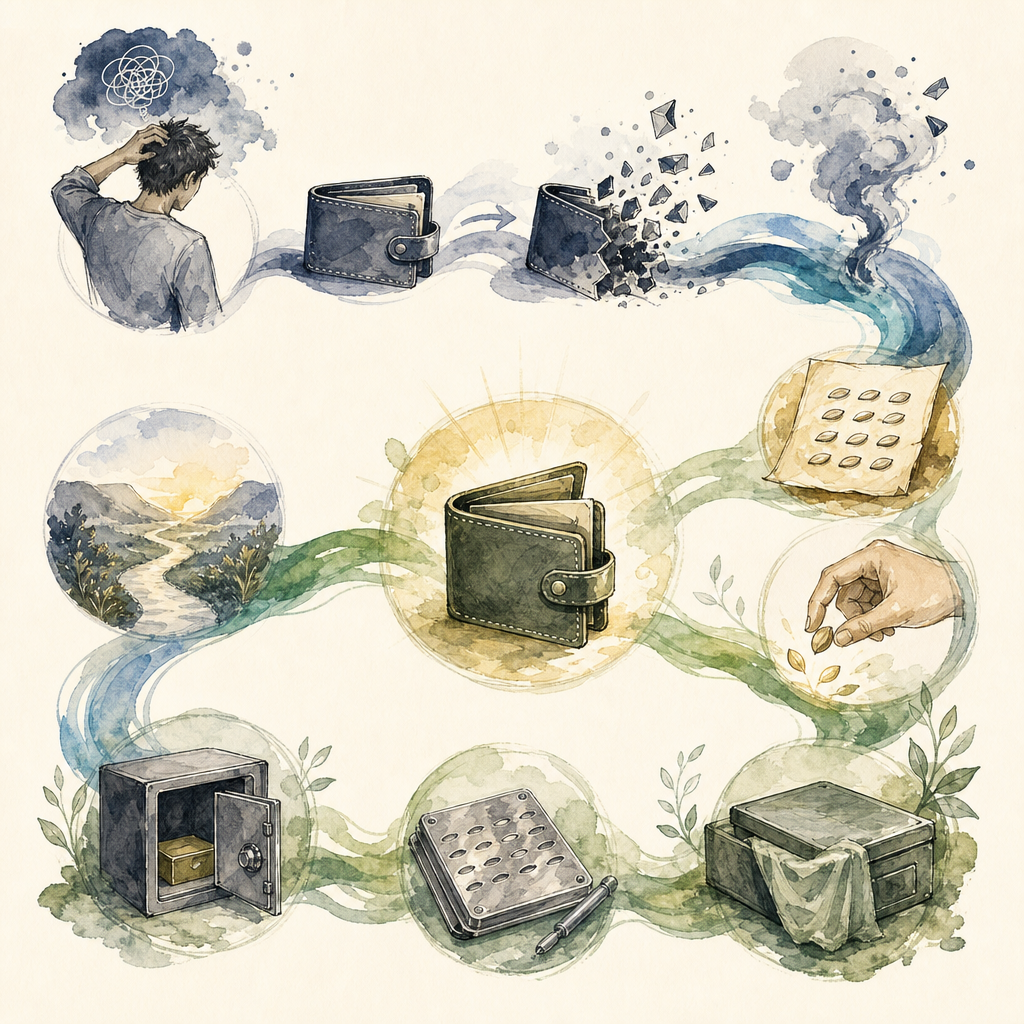
Seed phrases are rarely cracked. They are leaked, through habits that feel convenient.
Saving it in notes, email or cloud storage. If the account is compromised, or syncs to a device you do not control, the phrase goes with it.
Taking a screenshot or photo. Images are backed up and shared automatically, and malware searches photo libraries for exactly this.
Typing it into the wrong place. Phishing pages copy the look of popular wallets and ask you to "restore", "verify" or "sync". Entering the words there hands them over.
Leaving the paper somewhere obvious. Paper is a good medium. A sheet in a desk drawer labelled with the name of the wallet is not good storage.
How to store a seed phrase
A storage plan has to survive theft, fire, water and your own memory.
Make two offline copies and keep them apart. For example, one in a safe at home and one in a bank deposit box or another secure place. A single copy is a single point of failure.
Choose the medium by what is at stake. Paper is fine for modest amounts. For holdings you would be seriously hurt to lose, a metal backup resists fire and water far better.
Label it discreetly. Do not write "Bitcoin seed phrase" at the top. Use a label only you will understand.
Write it down in private. Away from security cameras, phone cameras and webcams, and without anyone helping.
Test the backup. Restore the wallet from your written copy on a spare device, check that the addresses match, then wipe that device. A backup you have never tested is a hope, not a backup.
Plan for the unexpected. Decide how someone you trust could reach the funds if something happened to you, without giving them the words today.
The scams that target seed phrases
Fake support in direct messages. You ask a question in a public channel and someone with an official-looking profile offers help, then asks for the phrase or a screen recording. Real support never needs your seed phrase.
"Sync" and "migration" sites. A professional-looking page says your wallet must be validated or upgraded and presents a form with 12 or 24 boxes. Any website that asks for a seed phrase should be treated as a scam.
Airdrop and claim traps. You are promised free tokens if you restore your wallet on a site. If you want to try airdrops at all, use a separate wallet holding very little.
Screen-share "help" calls. Someone offers to walk you through a fix over a video call and gets you to open your backup while sharing your screen.
Clipboard malware. This goes after addresses rather than seed phrases: you copy an address and the malware swaps in the attacker's. Compare the first and last characters of every address after pasting.
Seed phrases and swapping crypto
A non-custodial swap has a simple shape. You send coins from your own wallet to a deposit address, and the coins you get in exchange are sent to an address you provided. SwapRocket works this way, with no account and no wallet connection, so it never sees or asks for a seed phrase. If any page claiming to be a swap service asks for one, leave.
The consequence is that the security of the swap ends at your wallet. Say you exchange BTC for ETH on the BTC to ETH exchange. The ETH arrives at the address you gave. If the seed phrase behind that address is sitting in a screenshot folder, the ETH is exposed from the moment it lands.
Three habits cover most of the risk:
- Receive into a wallet whose seed phrase you have backed up offline.
- Paste the receiving address and compare its first and last characters.
- After a swap into a new wallet, confirm the backup works before adding more.
This applies with extra force to privacy coins. People often meet seed phrases for the first time when they set up a Monero wallet for a swap such as BTC to XMR, and the privacy of the coin is worth nothing if the words are easy to find. The no-KYC Monero exchange guide covers the wallet side, and the post-swap security checklist covers what to do after the coins arrive.
A ten-minute checklist
- Find your seed phrase, in private.
- Check it is complete and in the right order.
- Write it out clearly, twice.
- Store the two copies in separate secure places.
- Delete any photo, screenshot or note that contains it. If one ever existed online, move the funds to a new wallet.
- Test recovery on a spare device.
Frequently asked questions
Are seed words and a recovery phrase the same thing?
Yes. Seed phrase, seed words, recovery phrase, mnemonic and backup phrase are names for the same thing: the list of words, usually 12 or 24 under the BIP39 standard, that recreates every key in the wallet. A few coins use their own format, such as the 25 words of a Monero wallet.
Is a seed phrase the same as a private key?
No. A private key controls one address. A seed phrase generates all the private keys in a wallet, so it controls every address the wallet has or will create.
Can I change my seed phrase?
Not the way you change a password. To get a new one, create a new wallet, back up its phrase and send your funds to it. Do this if you think the old phrase may have been seen.
Is a 24-word seed phrase safer than a 12-word one?
Both are far beyond what can be guessed when the wallet generates them properly. Twenty-four words give a larger margin, but in practice phrases are stolen through phishing and careless storage, not broken by guessing.
What happens if someone gets my seed phrase?
They can restore your wallet on their own device and send the funds anywhere. Blockchain transactions cannot be reversed, so if you suspect a leak, move everything to a new wallet immediately.
Should I ever enter my seed phrase on a website?
No. Connecting a wallet to a legitimate application is done through the wallet itself, with a signing prompt or a QR code. The only place to enter a seed phrase is the wallet software or hardware device you are restoring.