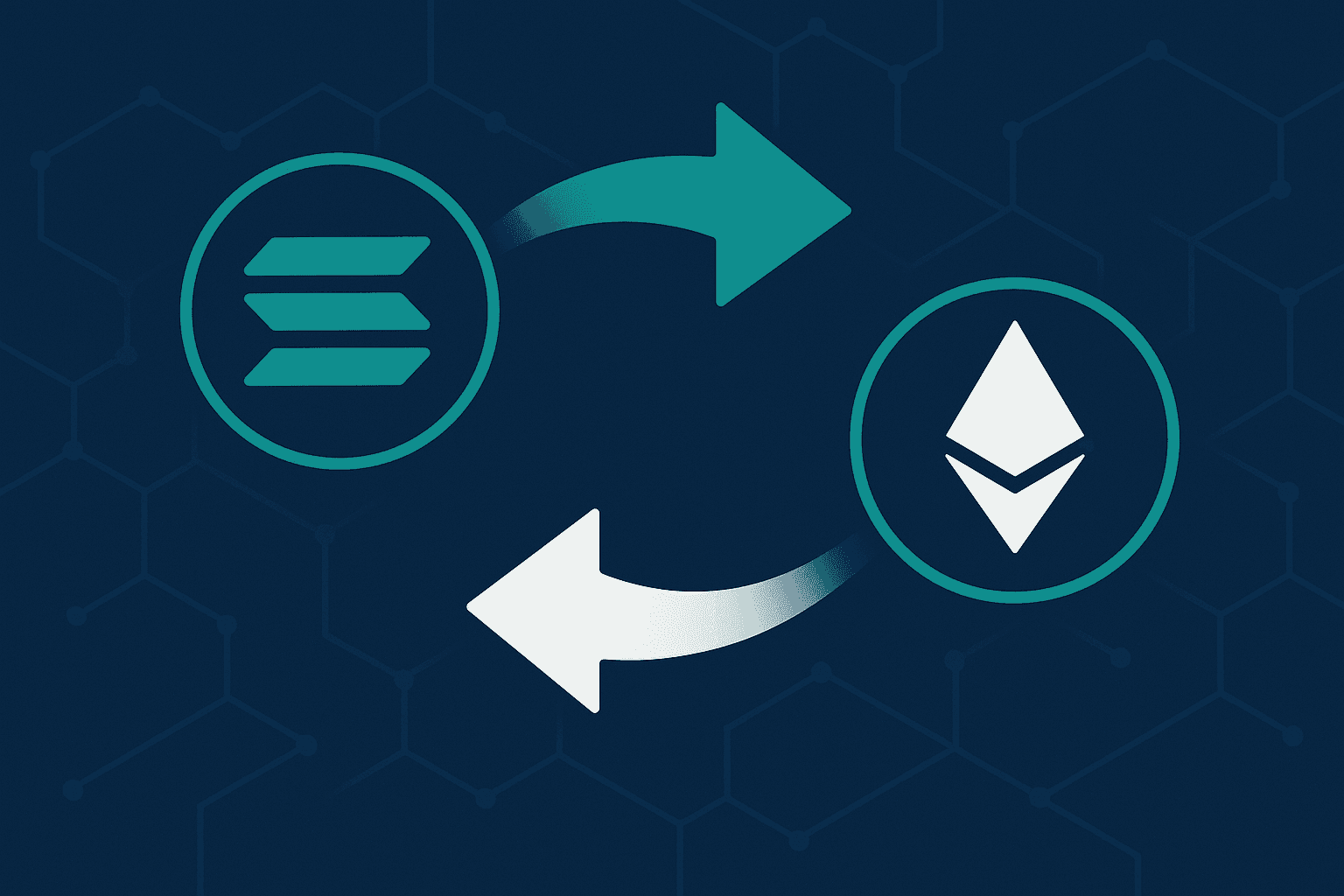
SOL to ETH Calculator: Real-Time Guide for Smart Swaps
Learn how to use a SOL to ETH calculator to check real-time rates, avoid bad swaps, and convert SOL to ETH safely with no KYC.
| Option | Custody | KYC Required | Speed (typical) |
|---|---|---|---|
| Centralized exchange (CEX) | Exchange holds funds | Yes, usually full KYC | 10–60 minutes (deposits + trades + withdrawals) |
| On-chain DEX (manual bridging) | You control keys | No, but complex | 15–60+ minutes (multi-step) |
| SwapRocket instant swap | You control keys | No KYC | Minutes (single flow) |
Ever tried to swap SOL for ETH, hit the button, and then realized you have no idea whether you got a good deal or not?
That feeling of: Did I just overpay? Did hidden fees eat half my profit? — that’s exactly why having a solid SOL to ETH calculator (and knowing how to use it) matters.
The good news: you don’t need to be a trading pro or math genius. With a good converter, you can see exactly how much ETH you’ll get for your SOL before you send anything — and still stay private, no KYC, no account.
- This guide walks you through:
- How a SOL to ETH calculator actually works
- How to use it to swap safely on a non-custodial, no-KYC platform like SwapRocket
- Practical tips to avoid bad rates, excessive fees, and nasty surprises
---
TL;DR / Quick Summary
- A SOL to ETH calculator shows how much ETH you’ll get for your SOL in real time, including fees and network conditions.
- On SwapRocket, the swap widget doubles as a calculator: enter SOL, see ETH output instantly, then swap if you like the rate.
- You stay in control of your funds (non-custodial) and don’t need KYC to convert SOL to ETH or other pairs.
- Always check: estimated rate, fees, minimum amount, and slippage before confirming a swap.
- You can also compare SOL → ETH with SOL → USDT or ETH → USDT using the converter to choose the best route.
---
Why You Need More Than Just Any SOL to ETH Calculator
If you search for a SOL to ETH calculator online, you’ll see dozens of tools. Most of them do only one thing:
They multiply the current SOL price by the SOL amount and divide by the ETH price.
That’s nice for a rough estimate, but when you’re actually moving money, it’s not enough. Real swaps involve:
- Network fees on Solana and Ethereum
- Liquidity and slippage
- Exchange or aggregator fees
- Minimum and maximum trade sizes
A calculator that ignores these can show you a beautiful number that you’ll never actually receive on-chain.
A practical SOL to ETH converter should:
- Pull real-time rates from multiple liquidity sources
- Show estimated output after fees
- Flag minimum amounts and network congestion
- Update quickly as markets move
That’s exactly what the SwapRocket interface is built to do when you use our exchange or dedicated SOL to ETH route.
How a SOL to ETH Calculator Really Works (Without the Math Headache)

Let’s demystify what goes on behind that simple input box.
When you type, say, 10 SOL into a SOL to ETH calculator tied to a real swap engine, here’s what typically happens behind the scenes:
- Spot prices are fetched The system checks current SOL and ETH prices across multiple sources (exchanges, DEXs, aggregators).
- Best route is calculated For something like SwapRocket, the engine looks for the best path: direct SOL → ETH or via another asset (for example, SOL → USDT → ETH) if that gives you more ETH.
- Fees are estimated - Solana network fee (for sending SOL) - Ethereum network fee (for receiving ETH) - Platform or aggregator fee
- Slippage is factored in Markets move in seconds. The calculator shows an estimated output ETH amount, often with a small buffer to account for price movement.
- You see the final number The output number is your best estimate of how much ETH you’ll actually receive if you swap now.
You don’t see all this complexity, and you don’t need to. But you should know: any SOL to ETH calculator that’s not connected to live liquidity is just a price bot, not a realistic swap tool.
Using SwapRocket as Your SOL to ETH Calculator (and Swap Tool)
On SwapRocket, the interface you use to swap is your SOL to ETH calculator. You can check numbers without committing to a trade.
Here’s how to use it step by step.
Step 1: Go to the SOL → ETH swap page
You’ve got two easy options:
- Go directly to the SOL to ETH page, or
- Open the main exchange and choose SOL in the first dropdown and ETH in the second.
You’ll see two fields: one for the amount of SOL you send, one for the ETH you’ll receive.
Step 2: Enter the SOL amount
Type in how much SOL you want to convert.
Instantly, the calculator will show:
- Estimated ETH output
- Current exchange rate (SOL → ETH)
- Minimum amount (if your trade is too small)
You can treat this as a pure calculator at this point. You don’t have to connect a wallet or send anything yet.
Step 3: Review the details
Before you turn the calculator into a real swap, look for:
- You send: the exact amount of SOL required (including any extra for fee buffer)
- You get: the ETH you’ll receive at current rates
- Estimated arrival time: usually a few minutes, depending on network load
If the numbers make sense, you’re ready to move on.
Step 4: Provide your receiving ETH address
SwapRocket is non-custodial, so you always receive funds directly in your own wallet.
- Paste your Ethereum wallet address (from MetaMask, a hardware wallet, or another non-custodial wallet)
- Double-check it carefully — this is where your ETH will go
No account, no login, no KYC form. Just your addresses.
Step 5: Send your SOL
Once you confirm the quote, SwapRocket will show you a deposit address for Solana.
- Send exactly the displayed amount of SOL from your wallet to that address
- After the transaction confirms on Solana, the engine completes the swap and sends ETH to your address
You can track the progress on a status page. Most SOL → ETH swaps complete in minutes, depending on Ethereum congestion.
If you’ve ever swapped BTC for ETH, the process will feel familiar. If you want a deeper walkthrough of cross-chain logic, our BTC to ETH Conversion Guide explains the flow in a similar way.
SOL to ETH vs SOL to USDT: Which Swap Makes More Sense?
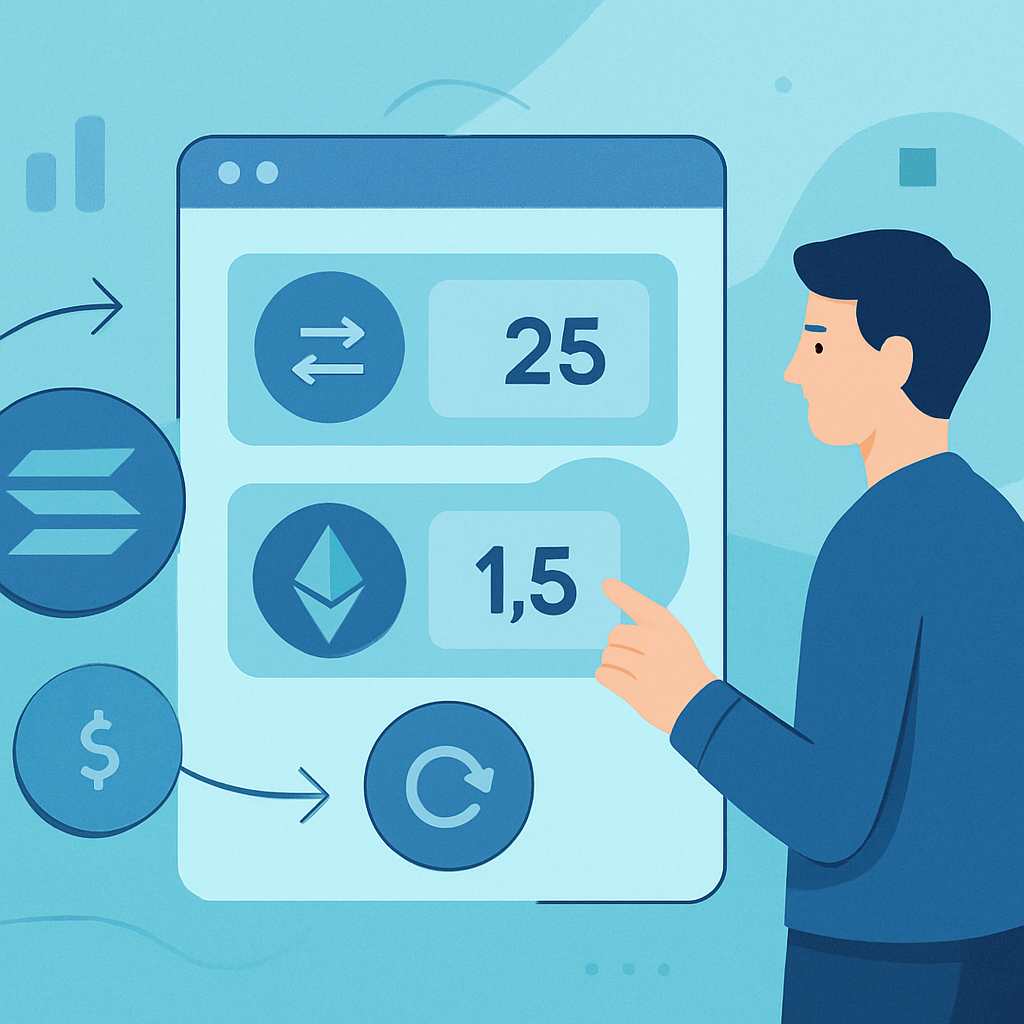
Sometimes you’re not sure whether to go straight SOL → ETH, or move into a stablecoin like USDT first.
That’s where a flexible converter really shines.
On SwapRocket, you can quickly compare:
- SOL to USDT
- ETH to USDT
- And even BTC to USDT if you’re managing a broader portfolio
A common strategy looks like this:
- If markets are volatile and you want safety → SOL → USDT
- If you’re rotating into the Ethereum ecosystem (DeFi, NFTs, L2s) → SOL → ETH
Use the converter as a multi-purpose calculator to see which path gives you a better result today.
Comparing Your Options: Where to Calculate and Swap SOL to ETH
You basically have three main ways to convert SOL to ETH in practice.
Here’s a quick comparison:
A simple web calculator on a CEX shows you numbers, but:
- You still have to deposit SOL into the exchange
- Complete a KYC process in most cases
- Trade SOL → USDT → ETH manually
- Then withdraw ETH (with another fee)
With something like SwapRocket, the calculator is wired into a real, non-custodial swap engine:
- You keep control of your wallet
- No signup or identity verification
- SOL in, ETH out, in one clean flow
Avoid These Common SOL → ETH Conversion Mistakes
A calculator reduces guesswork, but it can’t protect you from everything. These are the mistakes that quietly cost people money.
Mistake 1: Ignoring the network
Solana is fast and cheap. Ethereum can be fast or expensive, depending on the moment.
If gas is high, your effective SOL → ETH rate can suffer.
Before confirming a swap, check:
- Ethereum gas conditions (many wallets show this)
- Estimated arrival time in the SwapRocket quote
If Ethereum is super congested, you might:
- Wait a bit
- Or temporarily park in USDT via SOL to USDT and move into ETH later
Mistake 2: Only looking at the headline rate
A pretty exchange rate doesn’t mean much if fees eat the difference.
A good SOL to ETH calculator should already include:
- Platform fee
- Estimated network fees
- Route efficiency (e.g., SOL → ETH vs SOL → USDT → ETH)
On SwapRocket, when you preview a swap, the output ETH amount is what really matters. That’s the number you should compare, not just the displayed rate.
Mistake 3: Sending from or to the wrong type of wallet
This is a big one.
- Always send from a wallet where you control the keys (Phantom, Solflare, hardware wallets, etc.)
- Always receive ETH to an EVM-compatible non-custodial wallet (MetaMask, hardware wallet, etc.)
Avoid sending to:
- Exchange deposit addresses that don’t support cross-chain swaps properly
- Contracts or special staking addresses unless you know exactly what you’re doing
Because SwapRocket is non-custodial, funds go directly to your wallet. That’s powerful — but it also means you need to paste the right address.
Mistake 4: Overlooking minimum amounts
Every swap has a minimum amount to:
- Cover network fees
- Make routing efficient
If your SOL amount is too small, a calculator may show a poor rate or reject the quote entirely. In that case, consider:
- Combining multiple small SOL amounts into one transaction
- Or leaving tiny dust amounts where they are
Getting the Best SOL to ETH Rate: Practical Tips
You don’t control the market, but you can control how you interact with it.
Here’s how to use a SOL to ETH calculator intelligently.
1. Check multiple scenarios quickly
Use the SwapRocket interface as a sandbox:
- Try 5 SOL, 10 SOL, 20 SOL and see how output ETH changes
- Compare SOL → ETH with SOL → USDT and ETH → USDT
Because the platform aggregates liquidity for 200+ cryptocurrencies, sometimes a slightly different route gives you a better effective rate.
2. Time your swap when volatility calms down
Wild candles mean:
- Higher spreads
- More slippage
- Quotes that expire fast
If your calculator shows big swings in ETH output when you tweak the amount, markets may be too jumpy. Waiting even 15–30 minutes can make a real difference on larger amounts.
3. Use stablecoins as a stepping stone
If your end goal is to rebalance your portfolio (not just grab ETH immediately), you can:
- Move SOL → USDT first
- Then convert USDT → BTC, ETH, or other assets later
Our BTC to ETH Conversion Guide explains how traders often pass through stablecoins to avoid being forced into bad rates during market chaos.
And if you frequently manage positions in multiple coins, bookmark these tools:
- Exchange for direct pairs like SOL → ETH or BTC to ETH
- Converter to quickly calculate in any direction (SOL, ETH, USDT, BTC, and more)
4. Watch total portfolio exposure
A SOL to ETH calculator helps on a trade-by-trade level.
But zoom out and ask:
- How much of your stack is in Solana vs. Ethereum?
- Are you overexposed to one ecosystem?
Sometimes the best use of a calculator is simply realizing you’re already too heavy on one side and choosing to wait.
Why Use a Non-Custodial, No-KYC SOL to ETH Converter?
Most major exchanges now require full KYC: ID documents, selfies, sometimes even proof of address.
If you value privacy, or you just don’t want one platform holding your entire identity and funds, that’s not ideal.
SwapRocket takes a different approach:
- Non-custodial: You control your keys and your wallets. We never hold your long-term balance.
- No KYC: Convert SOL to ETH, BTC, USDT and 200+ coins without uploading ID.
- Fast swaps: Most swaps confirm in minutes, not hours.
- Aggregated liquidity: Our engine searches multiple routes to get competitive rates.
- Simple interface: Clean, calculator-style layout that works well on both desktop (where ~57% of traffic comes from) and mobile.
You can also:
- Use buy crypto to get your first SOL or ETH with a card
- Use sell crypto when you want to off-ramp
All without turning your trading life into a paperwork session.
If you’re new to non-custodial tools, the FAQ and About pages walk through how swaps work, security principles, and what to expect.
Beyond SOL to ETH: Other Popular Calculator Routes
If you’re using a SOL to ETH calculator, chances are you’ll eventually need other pairs too.
Here are a few that traders check often:
- BTC to USDT: Use our BTC to USDT converter to lock in gains in a stablecoin when Bitcoin pumps.
- ETH to USDT: Quickly see how much stablecoin you’ll get at current ETH prices via ETH to USDT.
- TRX to BTC: Rotate from Tron into Bitcoin when you want to consolidate into a more established asset.
- XRP to USDT, BNB to USDT: Typical rebalancing moves when you’re managing altcoin holdings.
The beauty of using one unified platform as your calculator and swap engine is consistency:
- Same interface
- Same privacy model (no KYC)
- Same non-custodial design
You don’t have to relearn a new workflow each time.
FAQ: SOL to ETH Calculator & Conversion
Is a SOL to ETH calculator 100% accurate?
Every good calculator shows an estimate based on current rates and fees.
Until your transaction is broadcast and confirmed, prices can move. That’s why SwapRocket shows you:
- Estimated output ETH amount
- Approximate arrival time
Small differences are normal in fast markets, but massive gaps usually signal either extreme volatility or a bad route on other platforms. Liquidity aggregation helps reduce this risk.
Do I need to create an account to convert SOL to ETH on SwapRocket?
No.
You can:
- Open the exchange
- Select SOL → ETH
- Use the calculator to preview your swap, and then complete it
All without registering, logging in, or submitting KYC.
Is SwapRocket safe for SOL to ETH swaps?
SwapRocket is non-custodial, which means:
- Funds move directly from your wallet to the target wallet
- There is no long-term hot wallet balance in your name
As with any crypto transaction, you should:
- Double-check addresses
- Start with a smaller test amount if you’re nervous
- Store larger holdings in secure non-custodial or hardware wallets
Our reviews and contact pages are good places to start if you want to see user feedback or ask specific questions.
Can I use SwapRocket as just a calculator without swapping?
Yes.
You can:
- Enter amounts
- Switch between pairs
- Compare outputs
…and simply close the tab if you decide not to swap. The interface works as a real-time SOL to ETH calculator (and a general crypto converter) as long as you’re online.
What if I want to learn more about other conversions?
If you’re interested in moving between chains frequently (like BTC → ETH, SOL → ETH, ETH → USDT), it’s worth reading more detailed guides.
You’ll find them on the blog, including our in-depth BTC to ETH Conversion Guide that explains cross-chain logic you can apply to many pairs.
Related Reading
If you found this SOL to ETH calculator guide useful, you’ll probably like:
- BTC to ETH Conversion Guide (No KYC)
- Check more tutorials and market insights on the SwapRocket blog
Ready to Turn the Calculator Into a Real Swap?
You now know how a SOL to ETH calculator works, what to watch out for, and how to avoid the most common conversion mistakes.
The next step is simple:
- Head to the SOL to ETH exchange page or main exchange.
- Enter your SOL amount and let the calculator show your ETH output.
- If you like the rate, paste your ETH address and complete the swap.
No accounts. No KYC. No handing over your keys.
Just fast, private, non-custodial swaps across 200+ cryptocurrencies — with real-time calculators built right in.
Try your first SOL to ETH calculation on SwapRocket now and see exactly how much ETH you could be holding in just a few minutes.
SwapRocket Team
Crypto Exchange Experts
The SwapRocket team provides expert insights on cryptocurrency exchanges and privacy-focused trading.
Compare Rates Instantly
SwapRocket aggregates rates from top providers. Find the best deal for your swap — no account needed.