Swap USDT Between TRC20, ERC20 & BEP20 (No KYC)
A practical guide to swapping USDT between networks (TRC20, ERC20, BEP20) safely—fees, pitfalls, and a fast no-KYC method.

| Network (USDT) | Typical transfer fees | Typical confirmation time | Where it’s commonly used | Best for |
|---|---|---|---|---|
| TRC20 (Tron) | Often ~$0.50–$2 | Usually 1–5 minutes | Many CEX deposits/withdrawals, cheap transfers | Low-fee USDT moves |
| ERC20 (Ethereum) | Commonly $3–$25+ (can spike) | Usually 2–10 minutes | DeFi, major platforms, deep liquidity | DeFi + broad compatibility |
| BEP20 (BNB Chain) | Often $0.10–$1 | Usually 5–30 seconds | BNB Chain apps, cheap on-chain activity | Fast + cheap transfers |
Maybe your exchange only accepts USDT-ERC20, but your friend paid you USDT-TRC20. Or you’re trying to move funds to a DeFi app on BNB Chain, and suddenly you’re staring at BEP20 vs ERC20 like it’s a trick question.
Here’s the good news: you’re not stuck. You just need to swap (or convert) USDT between networks the right way—without sending it into the void.
TL;DR (Quick Summary)
- USDT is the same “asset,” but different networks are different rails. TRC20 ≠ ERC20 ≠ BEP20.
- The #1 mistake is sending USDT on the wrong network to an address that doesn’t support it.
- If you want a simple route, you can use a no-KYC, non-custodial swap flow to go from one network/asset to another in minutes.
- On SwapRocket you can swap across 200+ cryptocurrencies with competitive rates via aggregation—without handing over your passport.
As of Feb 2026, crypto markets are still doing what they do best: moving fast and keeping everyone slightly on edge. That makes stablecoins like USDT even more popular—so knowing how to move USDT safely across chains is a real, practical edge.
The “USDT Problem” No One Warns You About
USDT is everywhere. It’s the checkout lane of crypto.But USDT isn’t one single token living in one place. It’s issued on multiple networks, including:
- Ethereum (ERC20)
- Tron (TRC20)
- BNB Smart Chain (BEP20)
- (And others like Solana, Polygon, etc.)
Think of USDT like a gift card brand. The brand is “USDT,” but the card might be valid only at certain stores (networks). If you try to swipe it in the wrong place, it doesn’t magically convert—it just fails, or worse, disappears into a black hole of unsupported deposits.
Why people get burned
Most wallets and exchanges show “USDT” as a single line item. That makes it feel interchangeable.But in the background, every deposit page is quietly asking: Which network?
If you’ve ever seen options like:
- USDT (ERC20)
- USDT (TRC20)
- USDT (BEP20)
…that’s not decoration. That’s the difference between “arrived safely” and “support ticket nightmare.”
TRC20 vs ERC20 vs BEP20: The Quick, Useful Comparison

Let’s make this concrete.
You care about three things:
- Fees (what it costs to move)
- Speed (how long it takes)
- Compatibility (where it’s accepted)
Here’s a simple comparison table you can actually use.
Two important notes:
- Fees vary with network congestion. Ethereum can be calm one hour and pricey the next.
- “Fast” depends on the receiver’s confirmation requirements (some exchanges wait longer than wallets).
The #1 Rule: Network Must Match on Both Ends
If you remember only one thing from this guide, make it this:You must send on the same network the receiving address supports.
- If the platform gives you a USDT-ERC20 deposit address, you must send USDT on Ethereum.
- If it’s USDT-TRC20, send on Tron.
- If it’s USDT-BEP20, send on BNB Chain.
“But the address looks the same…”
Sometimes addresses can look confusingly similar. For example:- Ethereum and BNB Chain addresses both start with 0x…
That does not mean they’re interchangeable in every context.
Some services support both networks to the same address, some don’t, and some will only credit one. If you’re not 100% sure, assume it’s not supported.
So… How Do You Swap USDT Between Networks?
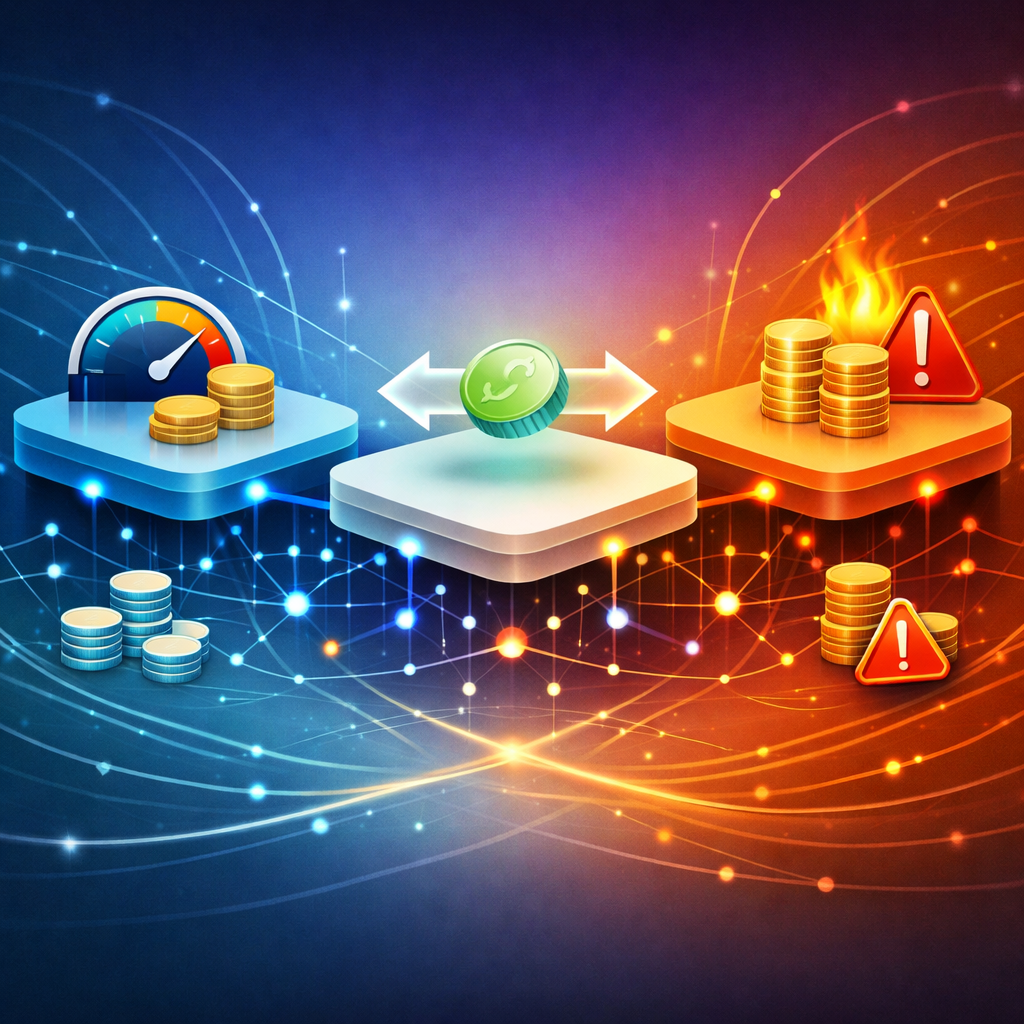
There are a few ways people do it. Each has trade-offs.
Option A: Withdraw from an exchange using the right network
If your USDT is on a centralized exchange and they support multiple networks, you can often choose the network at withdrawal.- Pros:
- Simple
- Cons:
- Many exchanges require KYC
- Network options vary
- Withdrawals can be delayed
Option B: Use a bridge (when available)
Bridges can move assets across chains.- Pros:
- Can keep you in stablecoins the whole time
- Cons:
- Bridge UX varies wildly
- Security assumptions are different per bridge
- Sometimes you still end up swapping assets anyway
Option C (Most straightforward for many users): Swap via a non-custodial, no-KYC instant exchange
This is the “I just want it done” route.Instead of trying to force USDT to jump rails directly, you swap from what you have to what you need—often in a single flow.
This is where a platform like SwapRocket shines.
- No KYC (privacy-first)
- Non-custodial flow (you’re not opening an account and parking funds)
- Fast swaps (typically minutes)
- Competitive rates through liquidity aggregation
- 200+ coins supported (so you have options if USDT route A is congested)
You can start right from the main exchange page.
The SwapRocket Method: A Practical Walkthrough (No KYC)
Let’s walk through a real-world scenario.Scenario: You have USDT-TRC20, but you need USDT-ERC20
This happens constantly:- You received USDT cheaply on Tron (TRC20).
- You want to deposit to a platform that only accepts Ethereum (ERC20).
Because “USDT across networks” isn’t always a direct one-click move everywhere, a common approach is:
- Swap USDT (TRC20) into an intermediary asset (or directly into the target form if available)
- Receive USDT (ERC20) at your Ethereum address
On SwapRocket, your process is designed to be straightforward:
Step 1: Choose what you’re sending and what you want to receive
Go to SwapRocket Exchange.- Select the coin/network you’re sending (for example, USDT on Tron)
- Select what you want to receive (USDT on Ethereum, or another asset that you’ll use on Ethereum)
If you’re still deciding, the converter is handy for checking conversion paths and getting a feel for rates before you commit.
Step 2: Paste the correct receiving address (and double-check the network)
This is where you avoid the classic mistake.If you’re receiving USDT-ERC20, paste an Ethereum USDT address (typically your ETH wallet address, but make sure it supports USDT/ERC20).
Quick safety checklist:
- The destination platform explicitly says USDT (ERC20)
- You’re using an address from that deposit page
- You’re not guessing based on “it starts with 0x”
Step 3: Send the exact amount to the provided address
SwapRocket will provide the address to send to.Send from your wallet, and keep an eye on:
- Network selection (TRC20 vs ERC20 vs BEP20)
- Minimum amounts (if shown)
- Confirmation progress
Step 4: Receive your funds—typically in minutes
Once the network confirms and the swap executes, you receive the output asset at the address you provided.If you’re new to this whole flow, it helps to read Your First Crypto Swap: Beginner Step-by-Step. It’ll make the “send → confirm → receive” rhythm feel normal fast.
Fees: What You’ll Pay (And Why It’s Not “Free”)
People love the phrase “free swap.” But in crypto, the costs usually show up in two places:- Network fees (paid to miners/validators)
- Exchange spread / service fee (the cost of conversion + liquidity)
Even if a platform advertises zero fees, the spread can still be there.
If you want a clear explanation (with real examples), read Free Crypto Swap? Understanding How Exchange Fees Actually Work.
A realistic example (numbers you can expect)
Let’s say you’re moving the equivalent of $500 USDT.- If you move it on ERC20, your network fee might be $3 to $25+, depending on congestion.
- If you move it on TRC20, it might be ~$0.50 to $2.
- If you move it on BEP20, it might be ~$0.10 to $1.
That’s why people often receive USDT on TRC20 (cheap), but need ERC20 (compatibility). The swap is essentially paying for “access” to the network you need.
Choosing the Right Network: A Simple Decision Tree
When you’re deciding where to hold or send USDT, use this logic:If you’re doing DeFi on Ethereum
Pick USDT-ERC20.You’ll pay more in gas sometimes, but you’ll have broad compatibility.
If you’re mostly moving USDT between people or exchanges
Pick USDT-TRC20 (often cheaper) if both sides support it.If you’re operating on BNB Chain apps
Pick USDT-BEP20.It’s fast and low-fee, and it plays nicely with BNB Chain ecosystems.
If you’re not sure what a platform supports
Don’t guess. Check their deposit page or FAQ.SwapRocket’s FAQ also covers common swap questions so you’re not flying blind.
Common Mistakes (And How You Avoid Them in 30 Seconds)
Let’s save you from the greatest hits.Mistake 1: Sending USDT on the wrong network
Fix: - Match the network exactly. - If there are multiple network options, select the one you intend.Mistake 2: Testing with “too little” and hitting minimums
Fix: - If you test, test with a meaningful small amount (like $20–$50) depending on stated minimums.Mistake 3: Forgetting memo/tag requirements (for some assets)
USDT itself typically doesn’t use memos the way XRP or XLM does, but if you swap into other assets, memo/tag rules can appear.- Fix:
- Follow the deposit instructions of the receiving platform.
Mistake 4: Mixing up “same address format” with “same network”
Fix: - Treat Ethereum (ERC20) and BNB Chain (BEP20) as different rails even if addresses look similar.“Non-Custodial” and “No-KYC” — What It Really Means for You
These words get thrown around a lot, so here’s the plain-English version.No-KYC: you keep your privacy
No uploading:- Passport
- Driver’s license
- Selfies
- Utility bills
That’s not about doing anything shady. It’s about minimizing data exposure. In 2026, data breaches are unfortunately routine, and less stored personal data often means less risk.
If you want the bigger picture, Privacy-First Crypto Swaps: Complete Guide to No-KYC & Anonymous Exchanges (2025) is a strong primer.
Non-custodial flow: you don’t “park” funds in an account
With a typical non-custodial swap flow:- You don’t create a custodial balance.
- You send from your wallet.
- You receive to your wallet.
That’s a different mindset than leaving funds sitting on an exchange “just in case.”
What If You Don’t Have USDT Yet?
Sometimes the real problem isn’t swapping networks—it’s getting your first crypto in a clean, simple way.SwapRocket has dedicated flows for that:
- Buy Crypto if you want to acquire crypto
- Sell Crypto if you want to cash out to supported options
And if you want to see what assets are available before you start, check Supported Cryptocurrencies (it’s a long list—200+ and growing).
Mini Playbook: 3 Real-Life USDT Network Scenarios
These are the situations I see constantly.1) “My exchange only accepts USDT-ERC20, but my wallet has TRC20.”
What you do: - Swap USDT(TRC20) → USDT(ERC20) (or a compatible asset) using SwapRocket Exchange - Deposit the ERC20 version to the exchange2) “I want cheaper transfers, but I still need Ethereum sometimes.”
What you do: - Keep spending/moving balance on TRC20 or BEP20 for day-to-day transfers - Convert to ERC20 only when you need Ethereum DeFi compatibility3) “I’m not sure which USDT network a platform supports.”
What you do: - Check their deposit page - If unclear, ask support before sending - Use SwapRocket’s FAQ to clarify swap mechanics and common gotchasWhen You Should NOT Swap USDT Between Networks
Swapping is useful, but it’s not always necessary.Avoid swapping if:
- The receiving platform already supports the network you’re on (just send directly)
- You’re moving tiny amounts and fees would eat you alive (e.g., $10 on ERC20 during high gas)
- You don’t urgently need USDT specifically—sometimes swapping into another asset (like ETH, BTC, or even another stablecoin) fits better
If your end goal is actually BTC or ETH, you can go straight there:
- Swap BTC/ETH pairs via Exchange
- For common routes, SwapRocket also has dedicated pages like BTC to ETH or BTC to XMR
FAQ-Style Answers (The Stuff You’d Normally Google at 2 AM)
Is USDT-TRC20 “the same” as USDT-ERC20?
It’s the same stablecoin brand (USDT), but issued on different networks. They’re not interchangeable unless you convert/swap.Why is ERC20 USDT more expensive to move?
Because Ethereum gas fees can be higher, especially when the network is busy.What’s the safest way to avoid losing funds?
- Match the network exactly - Double-check the deposit instructions - Consider a small test transfer (while respecting minimums)How long do swaps usually take?
It depends on the networks involved and confirmation requirements, but instant swap flows are often completed in minutes, not hours.Related Reading (Keep Going)
If you want to level up without drowning in jargon, these are worth your time:- Free Crypto Swap? Understanding How Exchange Fees Actually Work
- Your First Crypto Swap: Beginner Step-by-Step
- Privacy-First Crypto Swaps: Complete Guide to No-KYC & Anonymous Exchanges (2025)
Ready to Swap USDT Between Networks (Without KYC)?
If you’re done second-guessing networks and just want a clean, fast path from “what you have” to “what you need,” use SwapRocket.Start your swap here: SwapRocket Exchange
You get a privacy-first experience (no KYC), a simple non-custodial flow, and access to 200+ cryptocurrencies—so you can move value across chains without turning it into a week-long project.
SwapRocket Team
Crypto Exchange Experts
The SwapRocket team provides expert insights on cryptocurrency exchanges and privacy-focused trading.
Swap Now — No KYC Required
Follow the steps above and start your swap in under a minute. Non-custodial, anonymous, and fast.


