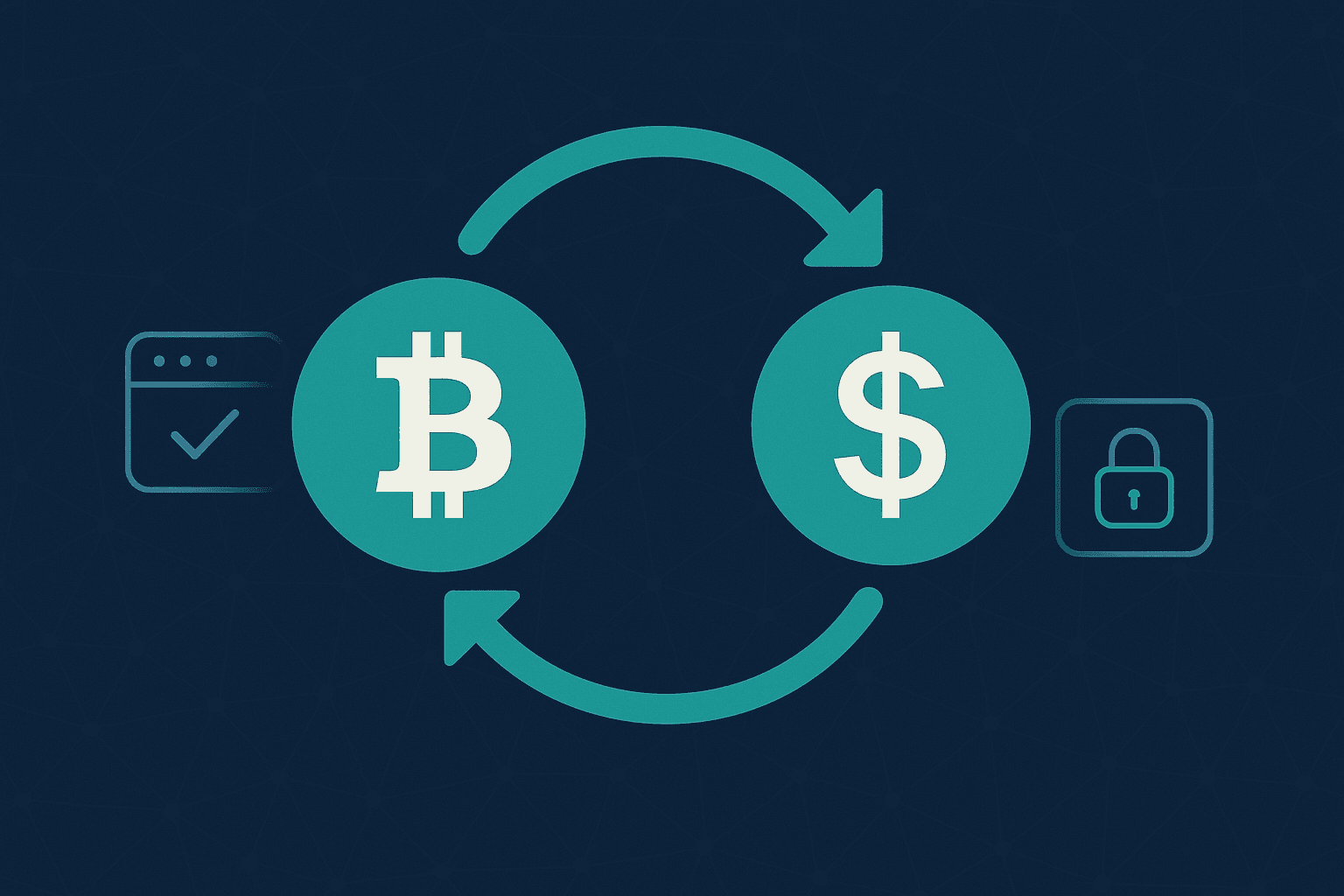
A cross-chain swap exchanges a coin on one blockchain for a coin on a different blockchain in a single step. You send Bitcoin, and Solana arrives. You send USDT on Tron, and ETH arrives on Ethereum. There is no bridge to operate, no wrapped token in the middle and no exchange account to fund first.
On the SwapRocket crypto exchange a cross-chain swap needs no account and no identity documents for standard swaps. You pick the pair, paste the address that should receive the new coin, and send from your own wallet.
Popular cross-chain pairs:
- A cross-chain swap changes both the coin and the blockchain at once.
- It is the simplest way to move between chains that do not talk to each other, such as Bitcoin, Solana, Tron and Monero.
- You need only a destination address. No wallet connection, no gas on the destination chain.
- A typical swap takes 5 to 30 minutes, set mostly by how fast the coin you send confirms.
- The one mistake that loses money is choosing the wrong network for a token that exists on several chains.
What a Cross-Chain Swap Actually Is
Blockchains are separate ledgers. Bitcoin cannot send a coin to Solana any more than a bank in one country can hand you cash in another. Something has to accept the coin on one side and pay out on the other.
In a cross-chain swap that something is a liquidity provider that holds reserves on many chains. You send coin A to a one-time deposit address on chain A. Once your deposit confirms, the provider pays coin B from its reserves on chain B to the address you supplied.
Three things follow from that design:
- You receive the native coin. Real SOL, real BTC, real XMR. Not a wrapped version that depends on a bridge staying solvent.
- You do not connect a wallet. There are no token approvals to grant and nothing to revoke afterwards.
- You do not need gas on the destination chain. Receiving is free, so you can arrive on a chain where you hold nothing.

Cross-Chain Swap vs Bridge vs DEX
Use a DEX when both tokens are on the same chain, and a bridge when you want the same asset on another chain. Use a cross-chain swap when the coin and the chain both change. The full comparison, with the main bridges, is in best cross-chain bridges compared.
How to Do a Cross-Chain Swap on SwapRocket
- Choose your pair. Start from a pair page such as BTC to SOL, or pick any two of the 700+ supported assets on the exchange page.
- Enter the amount. You see an estimate of what you will receive. The exchange fee and the payout network fee are already inside it, and the minimum and maximum for the pair are shown.
- Paste the destination address. This is your wallet on the chain of the coin you are receiving. SwapRocket validates the address against that network before the swap can start, so an address from the wrong chain is rejected instead of losing your funds.
- Add a refund address on the chain of the coin you are sending. If the swap cannot complete, the deposit comes back there.
- Send your deposit from your own wallet to the one-time address shown. Keep the swap ID.
- Receive the new coin. It is paid directly to your wallet once the deposit confirms. Nothing needs to be withdrawn.
Picking the Right Network
Most cross-chain mistakes are network mistakes. A ticker is not a network: USDT exists on Tron, Ethereum, BNB Chain, Solana and others, and each version is a separate asset.
| If the address looks like | The network is |
|---|---|
Starts with T, 34 characters | Tron (TRC20) |
Starts with 0x, 42 characters | Ethereum, BNB Chain or another EVM chain |
32 to 44 letters and numbers, no 0x | Solana |
Starts with bc1, 1 or 3 | Bitcoin |
Starts with 4 or 8, 95 characters | Monero |
Two rules cover almost every case:
- The destination address decides the receiving network. Choose the version of the token that matches the wallet you are sending to.
- Send the version you actually hold. If your USDT is on Tron, select USDT on Tron as the coin you send.
An 0x address is the awkward one, because the same address works on Ethereum, BNB Chain, Arbitrum and others. The format will not tell you which network a token is on, so read the network label on the pair page. More in TRC20 vs ERC20 vs BEP20.
How Long a Cross-Chain Swap Takes
The payout is sent as soon as your deposit has enough confirmations, so the coin you send sets the pace.
A typical swap takes 5 to 30 minutes. Where yours lands in that range depends on the deposit:
| You send | Where it usually falls |
|---|---|
| TRX, USDT on Tron, XRP, SOL | The fast end. These chains confirm quickly. |
| ETH and tokens on Ethereum | The middle of the range. |
| LTC, XMR | The middle to the slow end. Both need several confirmations. |
| BTC | The slow end, and longer when the Bitcoin network is busy. |
If a swap takes longer than expected, the usual reason is a low network fee on your deposit. See why crypto swaps get stuck.
What a Cross-Chain Swap Costs
Three things: the exchange fee, the network fee on each side, and any price movement while your deposit confirms.
SwapRocket includes the exchange fee and the payout network fee in the estimate you see before sending. You pay the network fee for your own deposit from your wallet, as with any transfer. Swaps run at a floating rate, so the final amount can end slightly above or below the estimate if the market moves during confirmation.
To keep the cost down, send from a cheap network where you have the choice, swap directly between the two coins instead of going through a third, and avoid very small amounts, where fixed network fees take the largest share.
What "No KYC" Means Here
For a standard swap SwapRocket asks for no account, no email and no identity documents. It is also non-custodial: funds pass from your wallet to the liquidity provider and back to your wallet, and are never held in an account in your name. See how no-KYC exchanges work for more.
Two honest limits. First, the transactions are still on public blockchains, so a swap is account-free, not invisible. Only a privacy coin such as Monero hides the on-chain side. Second, the licensed liquidity provider that executes the swap screens transactions, and it can hold a flagged one and ask for verification. That is rare for ordinary swaps.
Mistakes to Avoid
- Wrong network for the destination. Match the token version to the wallet.
- Using an exchange deposit address as the destination without its memo or tag. Coins such as XRP and XLM need one to credit an exchange account. Enter it in the tag field, or receive to your own wallet.
- Sending a different amount or coin than the swap expects. Send exactly what the swap page shows, in one transaction.
- Sending after the swap has expired. Start a new swap instead of reusing an old deposit address.
- Losing the swap ID. Support needs it to find your transaction.
- Copying an address from a search result or chat. Copy it from your own wallet and check the first and last characters.
Frequently Asked Questions
What is a cross-chain swap?
An exchange of a coin on one blockchain for a coin on another, done in one step. You send the first coin to a deposit address and receive the second at an address you provide.
Do I need a bridge to swap between blockchains?
No. A bridge moves the same asset to another chain. A cross-chain swap delivers a different, native coin without using a bridge or wrapped tokens.
Can I do a cross-chain swap without KYC?
Yes. SwapRocket needs no account and no identity documents for standard swaps. You provide a destination address and send from your own wallet. The liquidity provider screens transactions and can, rarely, ask for verification on a flagged one.
How long does a cross-chain swap take?
Typically 5 to 30 minutes. The time depends on how quickly the coin you send confirms. Bitcoin is the slowest common deposit and Tron, Solana and XRP are the fastest.
Is a cross-chain swap safe?
It avoids the main risks of bridges, because no smart contract holds your funds and nothing is wrapped. The risks that remain are user errors: a wrong network, a wrong address or a fake website.
What happens if my cross-chain swap fails?
The deposit is returned to the refund address you provided when you started the swap, minus network fees. Keep the swap ID so support can trace it.
Which coins can I swap across chains?
SwapRocket supports 700+ assets across the major chains, including Bitcoin, Ethereum, Solana, Tron, BNB Chain, Litecoin and Monero. See the supported cryptocurrencies.
Start a Cross-Chain Swap
Choose the pair, paste your address and send. The coin you want arrives in your own wallet.
Swap across chains on SwapRocket
Related guides: